
Description
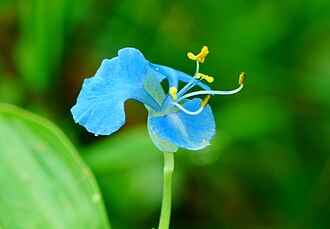
Commelina diffusa, commonly known as the spreading dayflower or climbing dayflower, is a pantropical herbaceous plant belonging to the Commelinaceae family. It is typically an annual but more often a perennial herb that grows in a prostrate to ascending manner, with extensive branching that can reach heights of up to 1 meter. The plant readily roots at its nodes, aiding in its spreading habit. It features lance-shaped leaves and distinctive bright blue flowers with three petals; two larger blue ones and one smaller white petal; that bloom from spring to fall. These flowers are short-lived, often lasting only a day, which contributes to its common name. The plant thrives in disturbed areas, moist soils, and forested environments, and it is widely distributed across tropical and subtropical regions worldwide.
Other Names
- English: Climbing Dayflower, Spreading Dayflower, Creeping Dayflower, French Weed, Pond Grass, Water Grass, Wandering Jew.
- French: Comméline diffuse, Herbe aux maux de gorge (Throat-ache herb)
- Chinese: Zhú jié cǎo (竹节草) – “Bamboo Node Grass”
- Japanese: Tsuyukusa (露草) – “Dew Grass”
- Sanskrit: Kena
- Tamil: Kaanavazhai (கானவழை)
- Brazil (Portuguese): Erva-de-santa-luzia (St. Lucy’s herb)
- Igbo: Okwu Onwa
- Yoruba: Atoju aterun; Ewe rodo (literally “leaf that is spicy/hot”)
- Hausa: Bàlààsánáá
Commelina diffusa is known by a variety of common names across different regions and languages, reflecting its widespread distribution.
Health Benefits
Commelina diffusa has a long history of use in various traditional medicine systems, particularly in Asia, Africa, and South America. It is important to note that many of these benefits are based on traditional use and preliminary scientific studies; more rigorous clinical trials are needed to confirm efficacy and dosage for modern therapeutic use.
- Anti-inflammatory and Analgesic Properties: In Traditional Chinese Medicine (TCM) and Ayurveda, the plant is commonly used to reduce inflammation and relieve pain. It is applied topically as a poultice or wash for swellings, burns, sore throats, and skin inflammations. Scientific studies have identified flavonoids and other compounds in the plant that exhibit anti-inflammatory effects.
- Antipyretic (Fever-Reducing): The plant has been traditionally used in decoctions to help reduce fever.
- Diuretic Effect: It is used in some traditions to promote urination, helping to flush out toxins and potentially supporting kidney and urinary tract health.
- Antimicrobial and Antiviral Activity: Extracts of C. diffusa have shown activity against certain bacteria and viruses in laboratory studies. This lends scientific support to its traditional use for treating infections, such as sore throats, tonsillitis, and urinary tract infections.
- Treatment of Digestive Issues: In some cultures, infusions made from the plant are used to treat diarrhea and dysentery.
- Detoxification and Liver Health: In TCM, it is sometimes used as part of formulas aimed at clearing heat and expelling toxins from the body, which is often associated with liver health.
- Rich in Vitamin C: Its leaves are rich in Vitamin C, which historically helped early settlers in Australia prevent scurvy; a disease caused by Vitamin C deficiency.
- Antioxidant Properties: It has shown antioxidant properties that may help prevent oxidative damage, slow aging, and reduce cancer risk.
- Antidiabetic potential: Recent work (ethyl-acetate fraction in animal diabetes models) has suggested glucose-lowering activity in preclinical studies; promising but not yet clinical.
- Traditional uses: It is reported to cool the blood, stop bleeding, clear heat, quell fire, expel wind dampness, and reduce swelling and inflammation. In Hawaii, it has been applied to treat deep cuts.
Other Benefits
- Edible Use: The young leaves and shoots of Commelina diffusa are edible when cooked. They can be consumed as a potherb (like spinach) and are a source of vitamins and minerals. The flowers are also edible and can be used as a garnish.
- Fodder: The plant is sometimes used as forage for livestock, such as pigs and cattle.
- Ecosystem Role: It provides ground cover, which can help prevent soil erosion in moist, shaded areas. Its flowers also attract pollinators. It can also behave as a weed in agricultural settings.
- Dye/pigment: The juice from its petals can be extracted to produce a blue dye, which has been used traditionally for coloring purposes.
- Cultural and Traditional Uses: used in some cultures for spiritual rituals like cleansing and protection.
How it is Used
The method of preparation depends on the intended use:
- Poultice or Compress: The fresh whole plant is crushed or pounded into a paste and applied directly to the skin to treat boils, burns, inflammations, and insect bites.
- Infusion/Tea: Fresh or dried aerial parts of the plant are steeped in hot water to make a tea. This is used internally for fevers, sore throats, coughs, and digestive issues.
- Decoction: A stronger preparation where the plant material is boiled for a longer period. This is commonly used in TCM and other systems for its diuretic and detoxifying properties.
- Juice: The fresh juice extracted from the stems and leaves can be consumed in small quantities or applied topically.
- Mouthwash/Gargle: A cooled decoction or infusion is used as a gargle to soothe a sore throat or tonsillitis.
- Dye: The petal juice is squeezed out to create dyes for fabrics or other materials.
- Cooked vegetable: Young shoots or leaf tips cooked as a green (food source) in some local diets.
- Extracts for research: Ethanol, methanol, ethyl acetate fractions and aqueous extracts are used in laboratory studies to evaluate pharmacological effects (antioxidant, antimicrobial, antidiabetic models). These research extractions are not the same as simple traditional preparations and yield concentrated phytochemicals.
Side Effects / Caution
While Commelina diffusa is generally considered safe when used appropriately, the following cautions should be observed:
- Toxicity: Acute toxicity studies in animals show a relatively wide margin of safety at doses used in some experiments (no adverse effects up to moderate–high doses in some reports), but higher doses produced signs of hypoactivity and behavioral changes in experimental animals in at least one study.
- Oxalate Content: Like many leafy greens, the plant contains calcium oxalate crystals. Consuming it in very large, raw quantities could potentially cause irritation to the mouth and digestive tract or contribute to kidney stones in susceptible individuals. Cooking typically reduces oxalate levels.
- Pregnancy and Lactation: Due to a lack of safety data, it is not recommended for use by pregnant or breastfeeding women.
- Allergic Reactions: As with any plant, some individuals may experience allergic reactions.
- Heavy Metal Contamination: As a plant that often grows in disturbed, moist soils (including roadside ditches), it can accumulate environmental pollutants and heavy metals. It is crucial to harvest from clean, uncontaminated areas.
- Drug Interactions: There is no known data on drug interactions, but its diuretic effect could theoretically interact with prescription diuretics.
- Ecosystem: Overharvesting can impact local ecosystems, and the plant should not be confused with toxic look-alikes.
- Consult a Professional: It is strongly advised to consult with a qualified healthcare practitioner or herbalist before using Commelina diffusa for medicinal purposes.
References
- Forseth, Irwin N., and Annette F. Innis. “Kahili Ginger (Hedychium gardnerianum) and Climbing Dayflower (Commelina diffusa): Invasive Plants in Hawaiian Ecosystems.” Weed Technology, vol. 18, 2004, pp. 1472-75. JSTOR, www.jstor.org/stable/3989637.
- Mahesh, Adepu, and Shaik Mohammad Khasim. “Phytochemical Studies and Pharmacological Properties of the Genus Commelina: A Review.” International Journal of Pharmaceutical Sciences and Research, vol. 11, no. 3, 2020, pp. 1037-46.
- “Commelina diffusa (Climbing Dayflower).” CABI Invasive Species Compendium, 2021, www.cabi.org/isc/datasheet/114091.
- Wang, Gui-Yuan, et al. “Ethnobotany, Phytochemistry, and Pharmacology of the Genus Commelina: A Review.” Journal of Ethnopharmacology, vol. 273, 2021, p. 113956. ScienceDirect, doi:10.1016/j.jep.2021.113956.
- Wu, Zheng-yi, and Peter H. Raven, editors. Flora of China. Vol. 24 (Flagellariaceae through Marantaceae), Science Press, Beijing, and Missouri Botanical Garden Press, St. Louis, 2000.
- “Commelina diffusa.” Wikipedia, Wikimedia Foundation, en.wikipedia.org/wiki/Commelina_diffusa. Accessed 17 Oct. 2025.
- “Commelina diffusa (spreading dayflower).” CABI Compendium, CABI Digital Library, 26 June 2023, www.cabidigitallibrary.org/doi/full/10.1079/cabicompendium.14979. Accessed 17 Oct. 2025.
- “The genus Commelina: Focus on distribution, morphology…” PMC, National Center for Biotechnology Information, 9 May 2024, pmc.ncbi.nlm.nih.gov/articles/PMC11112323/. Accessed 17 Oct. 2025.
- “Spreading Dayflower (Commelina diffusa).” Herbal Ramble, WordPress, 9 Apr. 2018, herbalramble.wordpress.com/2018/04/09/spreading-dayflower-commelina-diffusa/. Accessed 17 Oct. 2025.
- “Commelina spp.” Earth Medicine Institute, earthmedicineinstitute.com/more/library/medicinal-plants/commelina-spp/. Accessed 17 Oct. 2025.
- “Commelina diffusa (climbing dayflower).” Go Botany, Native Plant Trust, gobotany.nativeplanttrust.org/species/commelina/diffusa/. Accessed 17 Oct. 2025.
- “Commelina diffusa.” Useful Tropical Plants, tropical.theferns.info/viewtropical.php?id=Commelina%2Bdiffusa. Accessed 17 Oct. 2025.
- “Commelina diffusa Burm. f.” National Parks Board (NParks), www.nparks.gov.sg/florafaunaweb/flora/5/1/5133. Accessed 17 Oct. 2025.
- “Commelina diffusa: common name details from PIER.” Pacific Ecosystems at Risk (PIER), Hawaiian Ecosystems at Risk project, 30 Sept. 2005, www.hear.org/pier/commonnames/details/commelina_diffusa.htm. Accessed 17 Oct. 2025.
- “Commelina diffusa Burm.f.” Plants of the World Online, Royal Botanic Gardens, Kew, powo.science.kew.org/taxon/urn:lsid:ipni.org:names:172020-1/general-information. Accessed 17 Oct. 2025.
- “climbing dayflower (Commelina diffusa).” iNaturalist, www.inaturalist.org/taxa/160818-Commelina-diffusa. Accessed 17 Oct. 2025.
- “Commelina diffusa (spreading dayflower).” Plantwise Knowledge Bank, CABI, 26 June 2023, plantwiseplusknowledgebank.org/doi/full/10.1079/pwkb.species.14979. Accessed 17 Oct. 2025.
- “Alikbangon / Commelina diffusa / climibing dayflower.” StuartXchange, www.stuartxchange.com/Alikbangon.html. Accessed 17 Oct. 2025.
- “Commelina diffusa.” Wikipedia, 2025, en.wikipedia.org/wiki/Commelina_diffusa. Accessed 17 Oct. 2025.
- Lansdown, R. V. “Commelina diffusa.” IUCN / Flora profile, 2018. (Wikipedia)
- “Commelina diffusa (spreading dayflower).” CABI Compendium, 26 June 2023, www.cabidigitallibrary.org.
- “Factsheet – Commelina diffusa.” Lucid Central / Keyserver Factsheet, (Plant identification database).
- Dagne, A. et al. “The genus Commelina: Focus on distribution, morphology and economic uses.” Plants (review/PMC article), 2024. PubMed Central.
- “Traditional uses, phytochemistry and pharmacology of Commelina diffusa: An updated systematic review.” ResearchGate / PhytoJournal paper, 2021.
- “Diuretic Activity and Toxicological Assessment of the …” Pharmacologia / Scialert (toxicity/diuretic study), 2014.
- “Acute toxicity and antidiabetic effect of the ethyl acetate fraction of Commelina diffusa.” Pakistan Journal of Pharmaceutical Sciences (PDF), 2024.
- “Commelina diffusa.” Useful Tropical Plants (theferns.info) — ethnobotanical uses and edibility.