
Description
Irvingia gabonensis, commonly known as African mango, bush mango, or wild mango, is a medium to large evergreen tree in the family Irvingiaceae. It is native to tropical Africa, ranging from Senegal and Ghana eastward to Uganda and south to Angola, including Nigeria, Cameroon, Gabon, and the Democratic Republic of Congo .
The tree typically grows 15–40 meters (50–130 feet) in height, with a bole (trunk) diameter of 0.7–1 meter at the base, sometimes developing buttresses up to 2–5 meters tall . The bark is greyish, smooth or slightly scaly, with a yellowish-brown to light yellow slash that is granular and mottled . The leaves are elliptic to obovate-elliptic, measuring 3.5–16 cm long and 1.8–7.5 cm wide. They are rather leathery, glabrous (smooth), dark and glossy above, paler beneath, with prominently reticulate (net-like) venation .
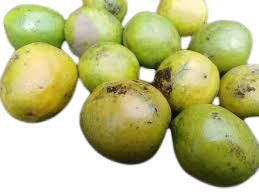
The flowers are small, fragrant, and greenish-yellow, clustered in few- to several-flowered umbel-like groups arranged in racemes or panicles up to 5 cm long . The fruit is a yellow, broadly oblong-ellipsoid drupe measuring 5–8 cm long and 3.5–7 cm wide, resembling a small mango in appearance . The skin is smooth, and the fruit hangs in clusters. The endocarp (stone) is hard, covered with dense, long, bristly fibers. Inside is a single seed (kernel) that is chestnut brown, glossy, woody, elliptic in outline, measuring 3–5 cm long, 2–3 cm wide, and about 1 cm thick . The kernel is the source of the commercially valuable “dika nut” and is used to produce “dika bread” and “ogbono” (the thickener for Nigerian soup).
Common Names
- English: African mango, African wild mango, Bush mango, Dika, Dika nut, Dika bread tree, Wild mango, Sweet bush mango
- French: Manguier sauvage, Chocolatier
- Igbo: Ogbono (specifically for the kernels used in soup), Udika
- Yoruba: Apon
- Hausa: Agbalo
- Edo (Afemai): Ogi (for the fruit)
- Cameroon: Andok (also Fang, Gabon), Ntwa
- Congo: Meba, Mueba
- Côte d’Ivoire: Boborou, Wanini
Health Benefits
Irvingia gabonensis has been employed in traditional African medicine for centuries, and modern research has begun to validate many of these uses. The kernels, bark, leaves, and fruit pulp all possess therapeutic properties.
1. Weight Management: African mango seed extract has gained popularity as a dietary supplement for weight loss. Studies suggest it may help reduce body weight, body fat, and waist circumference, although evidence quality is currently low. The mechanism is believed to involve the seed’s high fiber content and its potential effect on leptin (a hormone that regulates appetite).
2. Blood Sugar Control (Anti-Diabetic): The seeds have folkloric use as anti-diabetics, and research supports this. African mango may lower blood glucose levels, potentially through its fiber content and bioactive compounds . This suggests a possible additive effect when combined with conventional diabetes medications, warranting monitoring of blood sugar levels.
3. Cholesterol Reduction (Blood Thinner/Cardiovascular Health): Traditional use includes employing the seeds as “blood thinners.” Scientific studies indicate that African mango extract can help reduce LDL (bad) cholesterol and triglycerides while increasing HDL (good) cholesterol, contributing to overall cardiovascular health.
4. Digestive Health (Anti-Diarrheal): The ripe fruit pulp has been documented for its anti-diarrheal properties . The bark is also reported in traditional medicine for treating dysentery, colic, and various gastrointestinal ailments. In Senegal, the stem bark is used for gastrointestinal ailments.
5. Anti-Inflammatory and Antimicrobial Properties: Extracts from the fruit pulp and other parts have demonstrated anti-inflammatory and antimicrobial effects in studies, supporting their traditional use for various infections and inflammatory conditions.
6. Organ Protection (Hepatoprotective and Renal): Research indicates that the leaves possess the potential to enhance renal (kidney) and hepatic (liver) functions, protecting these vital organs against the toxic effects of harmful substances.
7. Rich Nutritional Profile: The fruit pulp is rich in vitamin C, carbohydrates, and proteins. The seed oil is a major constituent, primarily composed of myristic and lauric acids (saturated fats), while defatted seed extracts contain beneficial flavonoid glycosides and ellagic acid derivatives.
Other benefits
- Timber: The wood of Irvingia gabonensis is known as “andok” in the timber trade. It is used locally for construction, carpentry, and tool handles. The tree is also planted for shade and as an ornamental in villages and towns across the forest regions of West Africa.
- Culinary (Non-Health): The kernels (dika nuts) are highly valued throughout West and Central Africa. They are ground into a paste (often called “dika bread” or “ogbono”) which is used as a primary thickening agent for soups, most notably the Nigerian “ogbono soup”. The fruit pulp is consumed fresh, processed into juice, jam, or fermented into wine.
- Cosmetics and Body Care: The fat (oil) extracted from the seeds, sometimes called “dika butter” or “udika tallow,” is used in traditional skincare and hair care products due to its moisturizing and emollient properties.
- Economic Importance: The kernels are widely traded locally and internationally. The tree is a significant source of income for rural communities in West and Central Africa, as both the nuts and the fruits are sold in markets.
- Agroforestry: As a native, multipurpose tree, Irvingia gabonensis is often preserved and incorporated into farming systems. It provides fruit, timber, and shade, contributing to food security and sustainable land management.
How it is used
- Culinary uses:
- Ogbono Soup (Nigeria): The most famous use. The dried kernels are ground into a powder. This powder is added to boiling water or meat stock, where it dissolves and acts as a powerful thickener, creating the characteristic mucilaginous (slimy) texture of the soup. It is typically eaten with fufu, pounded yam, or eba.
- Dika Bread (or Dika Cake): The kernels are sometimes fermented, dried, and ground into a solid paste or cake. This “dika bread” can be stored for long periods and is used as a soup thickener or flavoring agent.
- Fresh Fruit: The ripe, yellow fruit pulp is eaten fresh, similar to a mango, although it is more fibrous. It is also made into juices, jams, and wine.
- Traditional medicinal uses:
- For weight loss: The seed extract is taken as a dietary supplement, typically at dosages between 150-3,200 mg daily alongside meals.
- For diarrhea/dysentery: Decoctions of the bark, leaves, or fruit pulp are drunk.
- For diabetes: Seed extracts are used, though blood sugar should be monitored.
- For skin conditions: The bark is applied topically for scabies, toothache, and various skin ailments. The oil (dika butter) is used as a moisturizer for dry skin and hair.
- For hepatic disorders /gonorrhoea (Senegal): The stem bark is employed for liver disorders and gonorrhoea.
- Fruit Pulp: Eaten fresh or juiced for nutrition and mild antidiarrheal effects.
- Bark/Leaves: Decoctions traditionally for dysentery, toothache, skin issues, fever, or wounds.
- Supplements: Standardized seed extracts (e.g., IGOB131) in capsules for metabolic support.
Side Effects / Caution
- Toxicity Profile: Encouragingly, acute toxicity studies have demonstrated the relative safety of Irvingia gabonensis extract at administered doses. One study documented no deaths within 7 days after a high dose (1,600 mg/kg) of African mango extract was given to rats. Another 90-day study in rats found no signs of toxicity or adverse effects at dosages up to 2,500 mg per kg of body weight daily.
- Allergies: Individuals with a known allergy or hypersensitivity to any components of African mango should avoid its use.
- Mild Adverse Reactions: In clinical studies, although side effects were mild and sometimes occurred at similar rates as placebos, reported reactions have included headache, dry mouth, flatulence (gas), sleep disturbances, and flu-like symptoms.
- Blood Sugar Interaction: African mango may lower blood glucose levels. Theoretically, this could lead to additive blood-glucose-lowering effects when combined with other anti-diabetic drugs. Individuals on medication for diabetes should monitor their blood sugar levels closely and consult a healthcare provider before using African mango supplements.
- Lack of Safety Data for Specific Groups: The safety of African mango has not been thoroughly assessed for pregnant or nursing women. Avoidance is generally recommended. Drug interactions have also not been adequately evaluated.
- Excess Consumption: May lead to digestive discomfort such as bloating or diarrhea due to high fiber content.
- Caloric Density: High fat content means excessive intake may contribute to weight gain if not moderated.
- Quality Concerns: Improper storage may lead to spoilage or contamination.
References
- “African Mango Benefits, Dosage, and Side Effects.” Examine.com, 12 Feb. 2026, examine.com/supplements/african-mango/.
- “African Mango Uses, Benefits & Dosage.” Drugs.com, 8 May 2025, www.drugs.com/npp/african-mango.html.
- “Andok (Irvingia gabonensis).” ITTO Tropical Timbers, www.tropicaltimber.info/specie/andok-irvingia-gabonensis/. Accessed 5 May 2026.
- “Irvingia gabonensis (Aubry-Lecomte ex O’Rorke) Baill.” Plants of the World Online, Royal Botanic Gardens Kew, powo.science.kew.org/taxon/urn:lsid:ipni.org:names:813766-1/general-information. Accessed 5 May 2026.
- “Irvingia gabonensis baill. (African Mango): A Comprehensive Review of Its Ethnopharmacological Significance, Unveiling Its Long-Standing History and Therapeutic Potential.” Journal of Ethnopharmacology, vol. 326, 2024, p. 117942. PubMed, doi:10.1016/j.jep.2024.117942.
- “Plants & People: Irvingia Gabonensis: The Untapped Diversity of Dika Plant.” USC Scalar, scalar.usc.edu/works/plants-and-people/irvingia-gabonensis-the-dika-diet.83.
- “African Mango Uses, Benefits & Dosage.” Drugs.com, https://www.drugs.com/npp/african-mango.html. Accessed 5 May 2026.
- “Irvingia Gabonensis – Uses, Side Effects, and More.” WebMD, https://www.webmd.com/vitamins/ai/ingredientmono-1252/irvingia-gabonensis. Accessed 5 May 2026.
- “Irvingia gabonensis.” Wikipedia, https://en.wikipedia.org/wiki/Irvingia_gabonensis. Accessed 5 May 2026.
- Food and Agriculture Organization. Non-Wood Forest Products of Central Africa: Irvingia gabonensis. FAO, 2001.
- Hassan, Y. R., et al. “Irvingia gabonensis Baill. (African Mango): A Comprehensive Review…” Journal of Ethnopharmacology, 2024. (via PubMed). Accessed 5 May 2026.
- Kothari, S. C., et al. “Subchronic Toxicity and Mutagenicity/Genotoxicity Studies of Irvingia gabonensis Extract (IGOB131).” Food and Chemical Toxicology, vol. 50, no. 5, 2012, pp. 1468–1479. Accessed 5 May 2026.
- Leakey, R. R. B., et al. “Domestication Potential of Irvingia gabonensis in West and Central Africa.” Forest Ecology and Management, vol. 134, 2000, pp. 111–123.
- National Research Council. Lost Crops of Africa: Volume II: Vegetables. National Academies Press, 2006.
- Ngondi, J. L., et al. “The Effect of Irvingia gabonensis Seeds on Body Weight and Blood Lipids of Obese Subjects.” Lipids in Health and Disease, vol. 4, 2005.
- Okafor, J. C. “Varietal Delineation in Irvingia gabonensis and Irvingia wombolu.” International Tree Crops Journal, vol. 4, 1987, pp. 143–152.
- Tchoundjeu, Z. “Irvingia gabonensis (Aubrey-Lecomte ex O’Rorke) Baill.” Plant Resources of Tropical Africa 14. Vegetable Oils, edited by H.A.M. van der Vossen and G.S. Mkamilo, PROTA Foundation, 2007, pp. 95-102. Accessed via AGRIS/FAO.