
Names:
- General: Pigeon wood; Charcoal tree;
- Igbo: Nri anuku; Telemukwu; Arira
- Yoruba: Afe idigbo
Description:
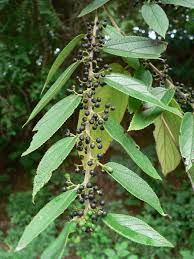
Nri anuku belongs to the family Cannabaceae. It grows as a tree that can attain up to 18m tall, with the brachlets covered with white hairs and has an extensive root system capable of invading soil in bags place over it. The leaves are simple, alternate, tapering from the base to the apex and vary from 2 to 20 cm long, and 1.2 to 7.2 cm wide. The leaf margins are finely serrated, whereas the young leaves are rough and hairy, occasionally becoming smooth when old. The flowers are small, inconspicuous, and greenish, carried in short dense bunches. The fruits are small, round, and dark purple or green drupes that become black when ripe, and they are carried on very short stalks. Birds of all sizes are very fond of the fruit and disperse the fleshy drupes.
Cultivation/Propagation
- The seeds are dispersed by birds and grows in any favorable soil.
Medicinal Benefits
- It is known to possess Laxative; Hypoglycemic; Anti-plasmodial; Diuretic; Anti-convulsant; Analgesic; Antibacterial; Anti-helminthic; Anti-sickling; Antioxidant; Hypoglycemic; Analgesic; Anti-inflammatory; Anti-plasmodial; Diuretic activity; Anti-convulsant; Anti-sickling; Anti-oxidant; Anti-bacterial; Antiviral; Antithrombotic; Cardiotonic; Anti trypanosomal; Antiulcer; Antimalaria; Antiepileptic; Antitumour (cytotoxic) activities.
- Used to manage hypertension; Convulsions; Diabetes; Metal poisoning; Bacterial infections; Sickle Cell Anaemia; Constipation; Diarrhea; Fever; and Pain.
- Used for the treatment of skin conditions, such as eczema and psoriasis, due to its anti-inflammatory and antimicrobial properties.
- The leaves and the bark are used to treat respiratory disorders including Asthma; Sore throat; Bronchitis; including tooth ache.
- Used for treating coughs, sore throat, asthma, bronchitis, gonorrhea, yellow fever, toothache, poisons, and dysentery.
- It is combined with other herbs for the management of hernia and scrotal swellings.
- Used for the treatment of Urinary tract infections including Gonorrhea.
- Used for the management of Yellow Fever and viral diseases.
- Used for managing dysentery and diarrheas.
- Management of Arthritis and relief of pain.
- Used for management of Diabetes.
- Used for the treatment of malaria
- Used as antidote for poisoning.
Other Benefits:
- The pulp is added to the pulp of other plants to increase strength and density of paper.
- Used for making cords, ropes, strings, and waterproofing fishing-lines.
- The bark yields black and brown dye used for textile manufacture.
- Used for making black powder, charcoal and gun powder.
- Used for soil conservation and reclamation.
- Used as shade tree in plantations.
- The leaves and fruits are edible.
How it is Used:
- It can be used as tea; tincture; or applied topically.
- When taken as tea, it should be steeped for10-15 minutes in hot water.
- It is made into tincture by soaking the plant in alcohol for several weeks.
- The leaves are crushed and applied on affected skin part.
- The decoction or infusion of the leaves with tender Carica papaya and Casia alata (one cup taken 3 times daily) is used for the management of hernia and scrotal swellings.
- The decoction of the roots is used for the treatment of trauma, hematuria, gastrointestinal bleeding, and blood stasis.
- The leaves macerated in lemon juice are used as remedy for cough, bronchitis, pneumonia and pleurisy.
- The juice obtained from macerating the soft wood is used for poulticing swellings.
- The stem bark decoction is used as vermifuge and treatment of dysentery.
- The wood is roasted and made into tea for the treatment of dysentery
- The stem bark and leaf decoction is used as gargle for the relief of toothache and taken for the treatment of:
- Malaria
- Muscle pain
- Bone pain
- Venereal diseases like gonorrhea.
- Yellow fever
- Poisoning.
- Aching bones
- Oral infections
- Anaemia
- Diarrhea and vomiting
- The leaves decoction is used:
- Mixed with the leaves of Bidens pilosa, Citrus aurantifolia and peels of unripe pineapple used for jaundice.
- For deworming in roundworm and hookworm infestations.
- For treatment of hypertension.
- As antidote of poisoning
- The root decoction is used for the treatment of:
- Gastrointestinal bleeding.
- Blood stasis
- Hematuria
- Trauma
Reported Side Effects/Caution:
- It should be taken with caution by persons on particular medications like anti hypertensives and antidiabetics because of interaction.
- It is generally considered safe when used in appropriate amounts. It can however have side effects in people with allergies.
References:
- https://www.dovemed.com/healthy-living/complementary-medicine/trema-orientalis-based-therapy/
- https://tropical.theferns.info/viewtropical.php?id=Trema+orientalis
- https://pfaf.org/user/Plant.aspx?LatinName=Trema+orientalis
- https://www.ncbi.nlm.nih.gov/pmc/articles/PMC3731882/
- https://en.wikipedia.org/wiki/Trema_orientale
- http://www.stuartxchange.org/Anabiong.html