
Names:
- General: Pattern wood; Stool wood; God’s tree; Cheese wood.
- Efik: Ebo; Ukpo
- Hausa: Kawo
- Igbo: Egbu
- Yoruba: Ahum
Description:
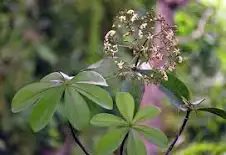
A very large, deciduous, evergreen, tropical-forest tree belonging to the Apocynaceae Family and distributed throughout the tropics and rain forests of West and Central Africa. It grows up to 45 metres (148 ft) in height and 3 m (9.8 ft) in girth, with high, narrow, deep-fluted buttresses. The leaves are borne in whorls at the nodes, the leaf shape is oblanceolate, with the apex rounded to acuminate and the lateral veins prominent and almost at right angles to the midrib. The flowers are yellowish-white and borne in lax terminal cymes. The fruits are pendulous, paired, slender follicles up to 16 centimetres (6.3 in) long, containing seeds bearing a tuft of silky, brown floss at either end to allow dispersal by the wind. The latex is white and abundant.
Cultivation/Propagation
- The seeds are dispersed by the wind but can be harvested and planted. The seed has a hard seedcoat which slows the rate of germination; which can be improved by soaking the seed in warm water for 12-24hrs before sowing.
- The tree snaps easily in strong wind and therefore should not be planted near buildings
Medicinal Benefits
- Alstonia boonei is listed in the African Pharmacopeia as an antimalarial and used across Africa for various ailments because of the following properties:
- Antirheumatic, anti-inflammatory, Analgesic.
- Anti-plasmodial (anti-malarial/antipyretic)
- Anti-Snake Venom
- Immune Stimulant
- Anti-helminthic.
- Anti-diarrheal.
- Antimicrobial.
- Abortifacient.
- Antipsychotic.
- Antimicrobial.
- Trypanocide.
- Hypotensive.
- Spasmolytic.
- Antidiabetic.
- Spasmolytic.
- Aphrodisiac.
- Antidiabetic.
- Antioxidant.
- Antipyretic.
- Astringent.
- Antibiotic.
- Sedative.
Other Benefits:
- It serves as timber that is traded internationally. It is used for light construction, light carpentry, open boats, moulding, furniture, interior joinery, implements, boxes, crates, matches, pencils, sculptures, and for veneer and plywood
- The Latex or rubber gives an inferior resinous coagulate, which has been used to adulterate better rubbers. It has been used as birdlime for trapping small birds.
- It is considered a sacred tree in some communities and can been found in sacred groves; consequently, it serves esoteric functions.
- The wood is a source of fuel as firewood.
How it is Used:
- As an infusion in cold or hot water, the stem bark is drunk as a cure for venereal diseases (Painful Urethritis in Gonococcus infection), Worm Infestation, Snakebite and Rheumatic Pains and to Relax Tense Muscles. It is also taken internally or used as a bath as a remedy for dizziness.
- The decoction is used for:
- the management of Lower Abdominal Pain and Pelvic Congestion associated with Gynecological Diseases as well as the management of Painful Menstruation associated with Fibroid and Ovarian Cyst.
- for relieving Fevers and other symptoms associated with Malaria Fever and for healing Intestinal Ulcers.
- for cleansing suppurating sores and exposed fractures, sores and ulcers.
- given after childbirth to help the delivery of the placenta.
- A liquid made from the stem bark and fruit is drunk once daily to treat impotence.
- An infusion of the root and stem bark is drunk as a remedy for asthma.
- The sap is used for treating snakebite and arrow poison.
- The bark is used to assuage toothache.
Reported Side Effects/Caution:
- Not to be taken by Pregnant Women because of its abortifacient properties.
- The latex is dangerous to the eyes and can cause blindness.
References: