
Names:
- General: Pawpaw
- Hausa: Gwanda
- Ibibio: Bobo
- Igbo: Okwuru-ezi, Okwuru- bekee, Mgbimgbi
- Yoruba: Ibepe.
Description:
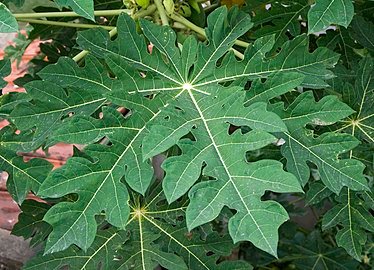
It is a fast-growing, evergreen tree that belongs to the family Caricaceae. It can grow up to 10 metres tall with a bole that could reach 30cm in diameter usually without side-branches, although these can be produced if the plant is injured or the growing tip is removed. The trunk is hollow and comparatively soft. It has deeply lobed leavesat the top, borne on hollow stalks that get up to 60 cm long. Male and female flowers are produced on separate plants, but hermaphroditic forms exist. The fruit is usually spherical to cylindrical in form, usually above 5cm and could be above 40cm in length; could weight up to 10kg or more. Within the inner walls of the central cavity are attached numerous seeds which are white when immature and wrinkled, black when matured. The unripe fruit contains a milky juice in which is present a protein-digesting enzyme known as papain, known to function like the animal enzyme pepsin in the digestive system.
Cultivation/Propagation
- The seeds from the matured fruit are usually planted and it takes 1 to 4 weeks to germinate in Nigeria. The seedlings can be replanted after 2 weeks after germination. Some species begin to fruit within 6 months after germination.
· Greenwood cuttings and Grafting have been used to propagate the plant.
Medicinal Benefits
- The antioxidants and vitamins are anti-inflammatory properties of the fruit prevent chronic inflammatory disease by ensuring cell membrane integrity, and improving nerve impulse transmission.
- The low sugar and high fiber content helps sugar and lipid metabolism thus helps support diabetics, lowers cholesterol and helps control metabolic disorders.
- Beta-carotene which is in the fruit helps to counter allergic and metabolic disorders like asthma, arthritis and inhibits the occurrence of cancers.
- The antibacterial property of papain and chymopapain in the plant promotes healing of skin wounds and treatment of skin ulcers.
- The fiber, antioxidants and potassium contents protect the heart against cardiovascular diseases.
- The Vitamin C content supports collagen synthesis which ensures healthy musculoskeletal system.
- Zeaxanthin, an antioxidant in the flesh protects retinal cells from damage and improves vision.
- Papain in the fruit promotes digestion, intestinal motility and eases the passage of stool.
- It is a good source of Lycopene believed to reduce the risk of prostate cancer.
- The leaves are used for the preparation of medication for treating malaria.
- It has folic acid that helps reduce the harmful proteins the body.
- The Vitamin A and C content boosts the immune system.
- It contains Vitamin K that supports bone health
- The Vitamin A content supports hair health.
Other Benefits:
- Papain, found in the latex in the skin of unripe fruits is added to cosmetic skin creams for improved skin health, control of termite, clarifying of beer, and degumming of natural silk.
- The juice from the back of the fruit which is rich in papain is used in the preparation of various remedies for indigestion and in the manufacture of meat tenderizers.
- The fresh or dried leaves can serve as substitute for soap.
- Young leaves are used for mulching.
How it is Used:
- The decoction of the leaves and the unripe fruit is taken as treatment for digestive disorders, diarrhoeal diseases, high blood pressure and painful menstruation and malaria.
- The root can be chewed for the treatment of Cough and Upper Respiratory Infections; as well as Gonorrhea. It also serves as an aphrodisiac, and expels worms.
- The decoction of the flowers serves to induce menstruation, treat upper respiratory disorders like laryngitis, bronchitis and treat Urinary Tract Infections.
- The juice from the unripe fruit helps to eradicate ringworm lesions; it is also applied externally to aid the healing of deep or slow-healing wounds.
- The latex is applied externally to wounds, boils, ulcers, warts and cancerous skin lesions and treating diseases of the gums and treating toothache.
- The seeds from the unripe fruit are taken whole for eradicating intestinal threadworms and roundworms and treat diarrhea.
- The boiled green leaves serve for the treatment of malaria and irregular bowel movement in children.
- Externally, the leaves are applied to wounds as a dressing that helps to speed the healing process.
- The decoction of the bark is used to treat diarrhoea, toothache, malaria and diarrheal diseases.
- An infusion of the young, latex-filled, green fruit is used as a children’s vermifuge.
- The immature fruit, sometimes combined with aspirin, is used as an abortifacient.
- The fruit pulp is mixed with fat in a pomade as remedy for abscesses.
- The root decoction is used to treat bladder and kidney diseases.
- The juice of the fruit is used to treat diabetes and hypertension.
- The juice of the unripe fruit is used to dissolve warts.
- The ripe fruit is used as a mild laxative.
Reported Side Effects/Caution:
- The latex from the unripe fruit can cause uterine contraction and could cause abortion and should be avoided in pregnancy.
- It is very safe to consume, but some people may experience allergic reactions from contact with the latex fluid of the unripe fruit.
- It has natural sugars and should be eaten in moderation by those who desire low sugar intake.
- Large quantity when consumed can have laxative effect.
References:
- https://www.pulse.ng/lifestyle/beauty-health/pawpaw-the-health-benefits-of-this-fruit-will-blow-your-mind/3nyvkzb
- https://www.news-medical.net/health/Papaya-Health-Benefits.aspx
- https://tropical.theferns.info/viewtropical.php?id=Carica+papaya
- https://www.ncbi.nlm.nih.gov/pmc/articles/PMC8066973/
- https://www.webmd.com/diet/health-benefits-papaya
- https://www.britannica.com/plant/papaya