
Names:
General: Jackal Berry; African Ebony; African blackwood
- Hausa: Kanya
- Fulani: Nelbi
- Yoruba: Kanram, Igidudu
Description:
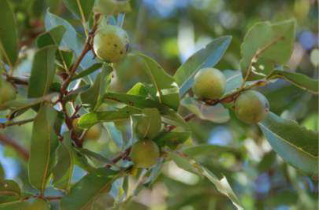
Diospyros mespiliformis is a tall, evergreen tree that can grow up to 50 m high, with dense, rounded and buttressed stem. The bark is grey-black or black and smooth in young trees but rough with small regular scales as the tree grows older. Young branchlets are green, tomentellous with pinkish white hairs, glabrescent later. The crown is very branchy with dense foliage.
The leaves are simple, alternate, alternately arranged, leathery, oblong to elliptical in shape (about 4 to 7cm long and 1.5 to 5.5cm wide), shiny above, paler beneath, and hairy when young and dark green with small hairs on the underside in old leaves.
The plant is dioecious (meaning male and female flowers are on separate trees). The Flowers are pentamerous, white and fragment. Male flowers are sessile hairy and clustered on axillary peduncles. Female flowers are solitary, shortly pediculate and axillary with 5-lobed calyx fruit is a fleshy berry, with an enlarged calyx yellow to orange when ripe The female tree bears fruits that are usually globose, fleshy, greenish and pubescent when young, yellowish to orange yellow and glabrous when ripe and about 20–30 mm in diameter, bell shaped, with persistent style and enlarged calyx and contain 4-6 seeds. The seeds are dark brown, bean-shaped shiny and glabrous.
Cultivation/Propagation
- The tree is easily propagated from seeds (their dormancy is broken by soaking the seeds in hot water for a few minutes), coppice cuttings, seedlings, and root suckers
Medicinal Benefits
- The leaves, barks, fruits, hard wood, and roots have been used as tonic, powder, and poultice to heal a wide range of illnesses such as asthma, dermatitis, hypertension, atherosclerosis, lumbago, hemorrhage, insomnia, and biliousness. Others include anaemia, diarrhoea, cough, ulcers, worm infestation, stomach aches, blood evacuation after childbirth, and fortification of mothers and new-borns.
- It is known to possess anti-inflammatory, anti-diabetic (hypoglycaemic), antihypertensive, antioxidant, anti-proliferative activities (anti-cancer), anti-hypersensitivity, antimicrobial, anti-parasitic, antiviral, antifungal, antiplasmodial, astringent, febrifuge, haemostatic, mild laxative, antidiuretic, stimulant, vermifuge, uterine stimulating, and analgesic properties.
- It is used for the treatment fevers, malaria, rheumatism, and digestive issues; support immune function and reduce inflammation; regulate blood sugar levels and manage diabetes; provide essential vitamins, minerals, and antioxidants; Support respiratory health and relieve coughs.
- It is known to contain alkaloids, tannins, saponins, flavonoids, steroids, cardiac glycosides, phenolic compounds, coumarin, triterpenoids, anthraquinones, anthocyanins, cardenolides and carbohydrates. It also has high fluoride content.
- It supports skin and hair health; treats insect bites and stings; used as a natural remedy for snake bites; supports bone health and reduces risk of osteoporosis.
- The dietary fiber in the fruit aids in digestion, promotes regular bowel movements, and helps prevent constipation.
- It is rich in vitamins A and C, essential minerals like potassium, magnesium, and calcium, and dietary fiber.
Other Benefits:
- The fruit is consumed fresh or dried (its flavour is lemon-like, with a chalky consistency), and can also be used to make jams, jellies, and beverages. It is a vital source of nutrition for both humans and wildlife.
- It helps in soil conservation and provides shade and shelter for various wildlife species, contributing to biodiversity and ecosystem stability.
- The dense, durable wood is used in high-quality woodworking, including furniture making, carving, and musical instrument production.
- It holds cultural significance in many African cultures, often featuring in folklore and traditional ceremonies.
- The fruit are sometimes dried and ground into flour, and are often used for brewing beer and brandy.
- The tree has multipurpose uses including timber, edible fruits, and traditional uses.
How it is used:
- The different forms of use are infusion, decoction, maceration, filtration, powder, boiled pulp, ash, vegetable brush (toothpick), direct consumption, pounding, small cushion (leaves rolled as a cushion), chewing, consumption after transforming on wine.
- Leaves:
- Infusion of the leaves is used in treatment of fevers, pneumonia, syphilis, leprosy and yaws. It is also used as astringent, febrifuge, hemostatic, mildly laxative, stimulant and vermifuge.
- The leaves and fruits are chewed or applied as infusion for treating gingivitis, toothache, and for wound dressing to prevent infection
- The infusion is used for wound dressings, and as an antidote for a variety of poisonous substances.
- The pounded leaves are rubbed into the skin for the treatment of skin diseases.
- Used for the treatment of headache, arthritis and skin infections.
- Root and Bark:
- The infusion of the root and bark is used for treating infections such as malaria, pneumonia, syphilis, leprosy, dermatomycoses, as an anthelmintic and to facilitate child birth.
- The bark preparations are administered to treat cough, bronchial diseases, tuberculosis, syphilis and leprosy, and applied externally to wounds, ulcers, bruises and furuncles.
- The infusion is used as psycho-pharmacological drug and to treat tremors.
- Roots and bark are used to stop purging and to enhance fertility
- The infusion is used for the management of Diabetes mellitus.
- The roots are consumed to purge parasites and treat leprosy.
- Used as psycho-pharmacological drug and to treat tumour.
- The bark is also used in veterinary medicine as vermifuge.
- Roasted and pulverized roots are taken to treat jaundice.
- An infusion of the bark is used to treat stomach ache.
- Fruits and Seeds:
- The seeds are also known to have nutraceutical value in managing high cholesterol, reducing risk of type-2 diabetes, and for weight control
- The crushed fruits is mixed with little water, and used to treat fungal infections, particularly as a mouthwash or douche, 3× per day.
- The fruit ash is applied to fungal skin infections and fruit powder to ulcers, whereas seed decoctions are administered against headache.
- The fruits decoction or infusions are taken to treat dysentery, diarrhea, and menorrhagia.
- It is crushed applied to treat fungal infection of the scalp.
- Bark and leaves:
- The infusion is used for the treatment of anaemia, diarrhoea, cough, ulcers, stomach aches and vomiting;
- Used for the managementblood evacuation after childbirth, and fortification of mothers and new-borns.
- Bark, leaves and roots:
- Treat ring worm infestation, dysentery and fever.
- Used to stop bleeding and heal wounds.
- Used for treating leprosy.
- A decoction obtained from the leaves or fruits, in association with the leaves of Vitellaria parodoxa (Shea tree), is taken orally (0.5 L) and applied topically on the body for the treatment of skin diseases or tonic.
- The bark is boiled and the blend is ingested for stomach problems, such as to stop vomiting or diarrhoea.
- Decoctions of roots or leaves are used as infusions to treat urinary and sexually transmitted infections.
- The twigs are chewed to clean teeth.
Reported Side Effects/Caution:
- While Diospyros mespiliformis and its products are generally considered safe, there are some considerations to keep in mind:
- Pregnant and breastfeeding women should consult with healthcare providers before consuming it in large quantities, especially in the form of traditional remedies.
- Consuming large quantities of the fruit may lead to digestive issues such as stomach cramps, bloating, or diarrhea due to its high fiber content.
- Some individuals may experience allergic reactions to the fruit or other parts of the tree, including skin irritation or respiratory symptoms.
- Individuals taking medication for chronic conditions should consult with healthcare providers to prevent drug interactions.
References:
- Gnonlonfin et. al. Proceedings of 6th NSCB Biodiversity Conference; Uniuyo 2018 (200 – 207 pp). Available @ https://www.researchgate.net/publication/369635474_Traditional_knowledge_and_cultural_importance_of_Diospyros_mespiliformis_in_Northern_Benin/link/64258a6692cfd54f843d9bb1/download?_tp=eyJjb250ZXh0Ijp7InBhZ2UiOiJwdWJsaWNhdGlvbiIsInByZXZpb3VzUGFnZSI6bnVsbH19
- Ahmed A.H and Mahmud A.F. Pharmacological activities of Diospyros mespiliformis: A review. Available @ https://www.academia.edu/35366907/PHARMACOLOGICAL_ACTIVITIES_OF_DIOSPYROS_MESPILIFORMIS_A_REVIEW#:~:text=According%20to%20the%20literature%20review,%2C%20Antiplasmodial%20and%20anti%2Doxidant.
- Shamsuddeen, I. (2023). Phytochemical Analysis of Diospyros Mespiliformis (African Ebony) Leaves and Bark. Direct Res. J. Biol. Biotechnol. Vol. 9(7), Pp. 74-78. https://doi.org/10.26765/DRJBB64290157 This article is published under the terms of the Creative Commons Attribution License 4.0.
- Ramadwa, T.E.; Meddows-Taylor, S. Traditional Uses, Pharmacological Activities and Phytochemical Analysis of Diospyros mespiliformis Hochsr. ex. A. DC (Ebenaceae): A Review. Molecules 2023, 28, 7759. https://doi.org/10.3390/molecules28237759
- Aminu, S. A., Y. Ibrahim, H. A. Ismail and Ibrahim, I. O. 2021. Medicinal and Traditional Utilization of African Ebony (Diospyros mespiliformi): A Review. Int.J.Curr.Microbiol.App.Sci. 10(06): 811-817. doi: https://doi.org/10.20546/ijcmas.2021.1006.086
- Orwa, C., Mutua, A., Kindt, R., Jamnadass, R., & Simons, A. (2009). Agroforestree Database: A tree reference and selection guide version 4.0. *World Agroforestry Centre*.
- Burkill, H. M. (1985). The Useful Plants of West Tropical Africa, Vol. 1. *Royal Botanic Gardens, Kew*.
- Omino, E. A., & Kokwaro, J. O. (1993). Ethnobotany of Apocynaceae species in Kenya. *Journal of Ethnopharmacology*, 40(3), 167-180.
- Ahmed, A. S., & Hussain, A. (2013). Nutritional composition and health benefits of Diospyros mespiliformis. *Journal of Food Science and Technology*, 50(5), 963-970.
- Nair, K. P. (2021). The African Ebony Tree: Agroforestry and Ethnobotanical Insights. *Springer*.
- https://plants.jstor.org/stable/10.5555/al.ap.flora.fz5470