
Names:
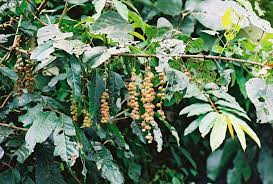
- General: Christmas bush; Cordifolia
- Hausa: Bambani; Bombana
- Igbo: Ububo; Ubebe
- Yoruba: Epa; Ipan-esin
Description:
Ububo is a shrub or small tree, straggling, laxly branched, evergreen dioecious tree that grows in swampy or dry areas, grows up to 10 meters tall and belongs to the family Euphorbiaceae. The young shoots are erect, later becoming horizontal, hollow, and glabrous. The leaves are alternate, simple; stipules triangular, long-stalked and broadly oval. The flowers are greenish in hanging clusters measuring 30 cm in length, grouped in spikes or racemes. Male flowers contain 2 cup-shaped sepals and stamens while the petals are absent. The female flowers with 2–4 lobed calyxes contain obtuse lobes, ovary, densely silky hairy but are exempted of petals. The fruit is a 2-lobed capsule measuring about 1.5 cm × 1.5 cm, the lobes are somewhat compressed, smooth, shortly hairy, green to red, and 2-seeded. Seeds are ovoid-ellipsoid, measuring about 6 mm long, smooth, bright red.
Cultivation/Propagation
- The mode of propagation is by seed or stem cuttings. The seeds germinate within 3 to 12 weeks when directly planted in moist soil.
- The seeds scatter easily and usually found in secondary forests.
Medicinal Benefits
- It contains a wide range of bioactive compounds, including flavonoids, tannins, saponins, and alkaloids, which contribute to its health benefits and possesses antidiabetic, analgesic, anti-inflammatory, antioxidant, , antipyretic, sedative, anti-stress, antidepressant, antimalaria, antimicrobial, antibacterial, antiviral, antispasmodic, antifungal, antiprotozoal, blood purifier, diuretic, emetic (in large doses), anti-sickling, antidiarrheal, antiviral, anti-helminthic, lympho-proliferative, immunostimulatory, anti-heamorhoid, abortifacient, emmenagogue, oxytocic, purgative, tonic and blood purification properties.
- Used for the treatment of:
- Toothache, dental caries, cough, bronchitis, Cold, cough, chills, bronchial problems, Asthma, sore throat, chest pain
- Venereal diseases, female sterility, Gonorrhea, threatened abortion, dysmenorrhea, prostatitis,
- Gastrointestinal disorders, hemorrhoids, stomachache, gastric ulcers, diarrhea, amoebic dysentery, worms
- Wounds, sores, sore feet, chancre, yaws, cicatrisation, external ulcers, leprosy, skin infections
- Hormonal-related gynecological disorders and infertility.
- Epilepsy, convulsions, insomnia, nervous disorders.
- Rheumatism, muscle pains, convulsion, fever.
- Microbial infections, gonorrhea, Yaws.
- Anemia, jaundice, and diabetes.
- Conjunctivitis, eye disorders.
- Poisoning, snake venom.
- Edema, constipation.
Other Benefits:
- The fruits are combined with fermented African locust beans (Parkia biglobosa) pods or the bark of Bridelia ferruginea; to make dye used on pottery, calabashes and leather.
- The leaves are used for packing cola nuts for storage and the food seasoning called ‘okpeye’ (fermented seeds of Prosopis africana).
- The wood is light, soft and perishable and is used for house construction, stakes and kitchen utensils, and benches.
- Chicken are known to produce egg yolks with a deeper yellow colour when fed regularly with the leaves.
- In veterinary medicine a leaf or root infusion is given to livestock to treat trypanosomiasis.
- Improves soil fertility and is known to be effective in restoring calcium levels in acid soils.
- Used for alley cropping for in-situ mulch production in banana or maize farm.
- The acidulous fruits are edible and are also used as bait to trap birds.
- The leaves and fruits are used for dyeing and preserving fishing nets.
- The leaves are used as forage for small ruminants and poultry.
- The stem bark is thrown in dammed streams as a fish poison.
- The wood is used in furniture and for house construction.
- The leaves can be cooked and serves as food.
- Dried leaves are used as tea substitute.
- It is used as a windbreak around crops.
- The leaves are eaten as an appetizer.
- The wood ash serves as a mordant.
- It is a shelter tree for crops.
- The wood serves as fuel.
How it is used:
- The leaves or leafy stems, as an infusion or chewed fresh is used for the treatment of the following:
- Genital and urinary diseases including sexually transmitted infections, and female sterility.
- Intestinal disorders like gastric ulcers, diarrhoea, amoebic dysentery, constipation and worms.
- Respiratory problems including sore throat, cough and bronchitis
- Facilitate delivery and promote abortion.
- Conjunctivitis when applied externally.
- Mouth ulcers, toothache and caries.
- Epilepsy, insomnia, and spasm.
- Impotency and female sterility.
- Menstrual disorders.
- Tachycardia.
- Anaemia.
- Edema
- The crushed fresh leaves or powdered dry leaves are applied externally to:
- Treat venereal diseases of the skin like sores, abscesses, yaws
- Serve as cicatrisant to wounds and to relieve pain.
- Improve healing and to treat eye infections.
- Treat skin infections and sore feet.
- Relieve backache and headache.
- Improve healing of fractures.
- Reduce enlarged spleen.
- Calm rheumatic pains.
- Treat vaginitis.
- Treat filariasis.
- The decoction of the leaves is used in baths:
- To combat female sterility, provide emmenagogue (stimulate blood flow in the pelvic area and uterus; stimulate menstruation) effect and treat venereal diseases.
- To treat fevers, sedate, stop spasm, control epileptic seizures and treat headaches.
- Treat abdominal complaints such as dysentery.
- As eyewash for conjunctivitis.
- The sap is used for:
- Topical application to sores, ulcers and skin-infections.
- The treatment of dental caries.
- The root decoction or maceration is taken to treat:
- Conjunctivitis especially blennorrhoea (chlamydial conjunctivitis) when used as eye drop.
- Urethral discharges when used as a wash.
- Amoebic dysentery and diarrhea.
- Venereal diseases.
- The powdered leaf, bark with fruit juice is applied externally for the treatment of:
- Hemorrhoids when applied as a suppository.
- Wounds, external ulcers and ringworm.
- Prolonged menstruation.
- The sap of the fruit is applied externally to treat:
- Eye infections
- Skin diseases.
- The pulverized leaves and root bark are applied externally to treat:
- Ulcers, yaws, chancre after previous treatment by baths with leaf decoction.
- Venom from snake bites (an antidote).
- Leprosy
- The decoction of roots or leaves is given by vaginal application for post-partum haemorrhage.
- Dried leaves or roots, alone or with tobacco, are smoked to cure cough.
- Twigs are used as chew-sticks against toothache and dental caries.
- The decoction of bruised fruit is taken to prevent miscarriage.
- The pith is rubbed on the chest to treat respiratory disorders.
- A decoction of fruits is taken to prevent miscarriage.
- The plant parts can be used for vapour baths.
Reported Side Effects/Caution:
- There are no recorded human side effects from the use and consumption of Ububo, but the following should be noted:
- It should be taken with caution by persons pregnant and breastfeeding mothers as well as those on other medications to prevent interactions.
- Some individuals may experience allergic reactions, such as skin rashes or itching, when using the plant topically. It is advisable to perform a patch test before widespread application.
- The safety of Alchornea cordifolia during pregnancy and breastfeeding is not well established. Pregnant or breastfeeding women should avoid using the plant or consult a healthcare provider before use.
- There is limited information on how Alchornea cordifolia interacts with other medications. It is important to consult a healthcare provider if you are taking other medicines before using this plant.
References:
- https://medcraveonline.com/PPIJ/a-mini-review-on-ethnomedical-uses-chemical-constituents-pharmacological-activities-and-toxicological-study-of-alchornea-cordifolia-schum-amp-thonn-muell-arg.html
- Agyare, C., et al. (2012). “An ethnopharmacological survey and in vitro confirmation of the antibacterial effects of Alchornea cordifolia.” *Journal of Ethnopharmacology*, 140(1), 272-279.
- World Health Organization (WHO). (2000). *General Guidelines for Methodologies on Research and Evaluation of Traditional Medicine*. WHO.
- https://guardian.ng/features/pioneering-herbal-cures-for-prostate-cancer-sickle-cell-anaemia-in-nigeria/
- https://www.sciencedirect.com/science/article/abs/pii/S0378874116303798
- https://tropical.theferns.info/viewtropical.php?id=Alchornea+cordifolia
- https://www.scirp.org/journal/paperinformation.aspx?paperid=48219
- http://uses.plantnet-project.org/en/Alchornea_cordifolia_(PROTA)
- https://greeninstitute.ng/plants/2018/9/16/alchornea-cordifolia
- https://www.tabletwise.net/medicine/alchornea-cordifolia
- https://onlinelibrary.wiley.com/doi/10.1111/and.12374