
Laportea aestuans
Names:
- General: Local Stinging Nettle, West Indian woodnettle
- Ibibio: Nkere
- Igbo: Agbara-ubi, Akugba
- Yoruba: Ofuefue, Ippe erin
Description:
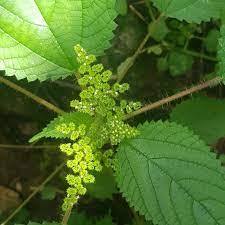
It is an annual plant/herb that grows up to 3m, also known as Fleurya aestuans and belongs to the family Urticaceae. Usually found in partially shaded, moist places, commonly available in Nigeria and often considered a weed. It is little-branched, with stem that is fleshy but becomes slightly woody at the base, and the whole plant is densely covered with stinging hairs up to 1mm long. The leaves are broadly ovate and coarsely serrated with numerous teeth at the margins. The Inflorescence is bisexual, paniculate, in the axils of upper leaves and can be up to 40 cm in length, covered with glandular and stinging hairs, with flowers which are unisexual and in clusters. The male flowers are scattered in the inflorescence and mixed with female ones which are mostly at the base. The fruits are ovoid, achene stipitate, laterally compressed on each side with a ring enclosing a warted area, and is dispersed with the perianth.
Cultivation/Propagation
- It grows in the wild annually from the dispersed seeds which grow once the environment is favorable (Wet and partially shaded)
Medicinal Benefits
- The essential oil which is rich in methyl salicylate has the following properties: Antioxidant; Antidiabetic; Antimicrobial; Anti-inflammatory; Diuretic; Antacid; Analgesic; Antirheumatic; Febrifuge; and Abortifacient.
- It is rubbed on the body for the treatment of fevers in children, edema, ulcers, and syphilic yaws.
- It can serve as a Laxative but has Antidiarrheal; Antidysentery; Anthelmintic properties;
- It is used for the management of Post Menopausal symptoms; Gonorrhea; and Leucorrhea.
- It is Reno-Hepatoprotective (protects the kidneys and liver); and promotes urine flow.
- Promotes digestion; and treats constipation.
- It is used as an antidote for poisoning
- It is used for the treatment of the following:
- Worm infestation; Indigestion; and Gastrointestinal ulcers.
- Headaches; migraines; and rheumatism.
- Cough and respiratory diseases.
- Wounds and abscesses.
- Menopausal disorders.
- Eye infections.
- Tooth ache
- Filariasis.
- Rickets.
- Hernia.
Other Benefits:
- The slightly mucilaginous leaves are often eaten as a vegetable in soups.
- The plant is a preferred food of the edible giant snail Achatina achatina.
- The phytochemical mucilage from the plant is used as adhesives.
- The stem yields a fiber used for thread, string and rope.
How it is Used:
- The inflorescence, combined with the seed of Aframomum melegueta (Alligator pepper), is eaten as a treatment for sore throat and hoarseness.
- The pulverized leaf or leaf sap, mixed with palm oil or kaolin is applied on abscesses, wounds and on the head of children to close the fontanel.
- It is eaten as a vegetable or in a soup to treat digestive disorders including stomach aches, indigestion and constipation.
- A leaf decoction is applied on swellings, instilled in the eye to treat minor eye infections and used for the relief of fever.
- Dried and powdered, the plant is rubbed into scarifications as a treatment for headaches and syphilitic yaws.
- The juice from the crushed leaves and flowers are used for the treatment of diarrhoea and dysentery.
- A maceration of the fresh leaf is used to massage the body for the treatment of intercostal pain.
- The leaf is roasted then ground in water and the liquid drunk as a treatment for gonorrhea.
- The crushed leaves pounded with clay and water is applied in enemas to treat dysentery.
- Slightly scorched or smoked, the leaves are applied to burns and used against migraine.
- The crushed stem is applied on affected body part for the treatment of inflammation.
- The pulp is mixed with CaCO3 and taken orally as treatment for intestinal ulcers.
- The juice from the pulped whole plant is used for the following:
- Antidote for poisoning
- Treatment of hernias
- Deworming
- The juice from the crushed leaves is used for the following:
- Treatment of:
- Urine retention; Create a diuretic effect (increase urine output)
- Fevers, pain, cough and other pulmonary disorders.
- Constipation and intestinal disorders
- Leucorrhea and menopausal disorders.
- Bedwetting and filariasis.
- Haemorrhages.
- Rheumatism.
- Create abortifacient effect
- Embrocation to strengthen rachitic children.
- Applied on the tooth to treat tooth ache.
- Applied on the abdomen to ease childbirth.
- Treatment of:
- Applied externally, the pulp is used for the following:
- Treatment of external ulcers and oedema.
- Treatment of fevers in children.
Reported Side Effects/Caution:
- It should be avoided in pregnancy as it is a known abortifacient.
References:
- https://punchng.com/nigerias-medicinal-plants-laportea-aestuans-ofiya/
- https://tropical.theferns.info/viewtropical.php?id=Laportea+aestuans
- https://uses.plantnet-project.org/en/Laportea_aestuans_(PROTA)
- https://www.ncbi.nlm.nih.gov/pmc/articles/PMC8168169/
- https://www.sciencedirect.com/science/article/abs/pii/S037887411500358X
- https://iopscience.iop.org/article/10.1088/1742-6596/1503/1/012041/pdf