
Description
Manihot esculenta Crantz, commonly known as cassava, is a perennial woody shrub belonging to the Euphorbiaceae (spurge) family. It typically grows to a height of 1.5 to 3 meters and is cultivated primarily for its large, edible, starch-rich tuberous roots.
The plant has an erect, branching habit. The leaves are alternate, papery in texture, and palmately divided into 3 to 9 (typically 5-7) narrow, lance-shaped lobes, resembling a hand with outstretched fingers . The leaf blades measure 10-20 cm across, and the petioles (leaf stalks) are long, measuring 8-22 cm, and are often reddish in color.
The flowers are small and arranged in terminal or axillary racemes (clusters) measuring 5-15 cm long. Male and female flowers are separate on the same plant. The flowers are typically purplish-red with a white powdery coating. The fruit is a capsule, ellipsoid in shape, measuring 1.5-1.8 cm long, with six narrow, wavy, longitudinal wings, giving it a rough appearance. The seeds are hard, smooth, and mottled with black spots.
Cassava is native to South America (western Brazil) and has been domesticated for over 10,000 years. It was introduced to Africa by Portuguese traders in the 16th century and is now extensively cultivated throughout tropical and subtropical regions worldwide, with Africa accounting for over half of global production.
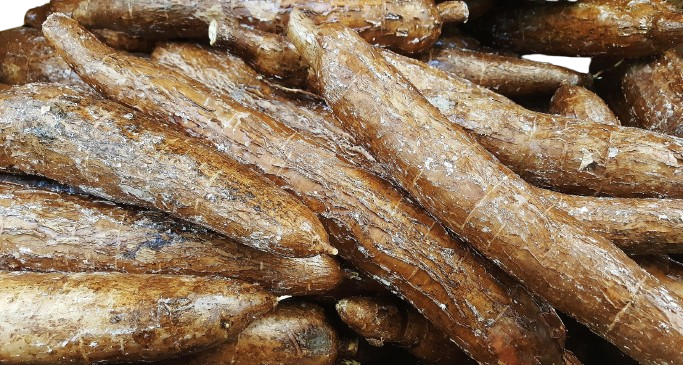
Common Names
- English: Cassava, Manioc, Yuca (not to be confused with Yucca), Tapioca (referring to the processed starch)
- Chinese: 木薯 (Mù shǔ)
- French: Manioc
- Spanish: Mandioca, Yuca
- Yoruba: Ege, Gbaguda
- Igbo: Abacha, Akpu
- Hausa: Doya Danzaria, Rogoro
- Ibibio: Iwa
- Urhobo: Icassava
- Indonesian: Singkong, Ubi kayu
- Thai: มันสำปะหลัง (Man sampalang)
- Swahili: Muhogo
- Tagalog: Kamoteng kahoy
Health Benefits
While cassava is primarily known as a staple food crop, both its roots and leaves possess several scientifically supported health benefits, largely attributed to their nutrient and phytochemical content. Cassava roots are primarily a source of complex carbohydrates (high starch content) and provide energy, with modest amounts of vitamin C, copper, potassium, and some B vitamins. Resistant starch in properly processed forms supports gut health by acting like soluble fibre, feeding beneficial bacteria, and aiding blood sugar management. Leaves are richer in protein, vitamins (A, C, K), iron, calcium, and fibre. Traditional and research-supported benefits include:
- Rich Source of Resistant Starch for Digestive Health: Cassava root is high in resistant starch, a type of starch that resists digestion in the small intestine and ferments in the large intestine, acting as a prebiotic. This promotes the growth of beneficial gut bacteria, improves digestive regularity, and enhances mineral absorption.
- Anticancer Potential (Leaves): A 2026 review published in Plant Foods for Human Nutrition highlights the anticancer properties of cassava leaves. The leaves contain secondary metabolites, including flavonoids, alkaloids, and tannins, which have demonstrated the ability to combat oxidative stress and chronic inflammation—key factors implicated in cancer initiation and progression. These compounds may help protect cells against various chronic diseases, including specific cancer types, though further clinical research is needed.
- Antioxidant, Anti-inflammatory, and Immune-modulatory Properties: The bioactive compounds in cassava leaves, such as flavonoids and other phenolics, exhibit antioxidant and anti-inflammatory activities that help safeguard cells against oxidative stress and chronic diseases. Cassava leaves have also demonstrated antibacterial, anti-diabetic, and immune-modulatory properties.
- Nutrient-Dense Leaves: Cassava leaves are rich in essential nutrients, including protein, calcium, iron, and vitamins A, B, C, and K . This makes them a valuable nutritional supplement in regions where protein and micronutrient deficiencies are common, provided they are properly processed to remove toxins.
- Gluten-Free Alternative: As cassava is naturally gluten-free, its starch and flour are excellent wheat alternatives for individuals with celiac disease or gluten sensitivity. Cassava flour is increasingly used in Western cuisine for baking and as a thickening agent.
- Traditional Medicinal Uses: In various traditional medicine systems, cassava has been used to treat hypertension, headache, pain, irritable bowel syndrome, and fever. The roots or leaves are used in traditional Chinese medicine (TCM) externally to “remove toxin and disperse swelling,” though this is for external application only due to toxicity concerns.
- Potential metabolic support: Some studies suggest anti-diabetic, hypocholesterolemic, and anti-hyperglycemic properties from bioactives; leaves may inhibit digestive enzymes.
- Wound healing and other: Traditional uses for sores, wounds, and skin issues; extracts show antimicrobial, anti-cancer potential (in vitro), and hepatoprotective/nephroprotective effects in some models.
Cassava contributes to food security and nutrition in tropical diets, though benefits are enhanced when combined with protein-rich foods. Many pharmacological claims derive from traditional use and preclinical studies; robust human clinical evidence for therapeutic doses is limited.
Other benefits
Cassava is Nigeria’s largest root crop and a key driver of rural economies, supporting millions of smallholder farmers as both food and cash crop. It provides year-round availability, drought tolerance, and high caloric yield per hectare.
- Staple Food Crop: Cassava is a fundamental staple food for over 800 million people worldwide, particularly in Africa, South America, and Asia. It is one of the most drought-tolerant crops, making it critically important for food security in arid and semi-arid regions.
- Culinary Uses:
- Roots: The tuberous roots are consumed boiled, fried, roasted, or fermented. They are processed into various traditional foods such as garri, fufu (known as akpu in Igbo), lafun, and tapioca.
- Leaves: In many African and Asian communities, cassava leaves are cooked as a vegetable soup or sauce, rich in protein and vitamins.
- Flour and Starch: Cassava starch is used as a thickener, binder, and texturizer in soups, sauces, baked goods, and processed foods.
- Industrial Applications: Cassava starch is a valuable raw material for numerous industries. It is used in the production of:
- Food products: Glucose syrup, sweeteners, biodegradable packaging.
- Biofuels: Ethanol production.
- Textiles and paper: As a sizing and finishing agent.
- Adhesives and plywood: As a binder.
- Animal feed: The roots, leaves, and by-products of processing are used as livestock feed.
- Environmental and Social Uses: Cassava has environmental uses, such as erosion control, and social uses in various cultural practices.
- Economic Importance: Widely cultivated and processed into various products for local and international markets.
- Animal Feed: Leaves and peels are processed into livestock feed.
- Agricultural Advantage: Tolerates drought and poor soils, making it reliable for farmers.
How it is used
- As Food (Roots):
- Boiled or Fried: Fresh roots are peeled, cut into pieces, and boiled or fried, similar to potatoes. This method is common in South America and parts of Africa.
- Garri: The most common processed form in West Africa. The roots are peeled, grated, fermented, pressed, and roasted into a dry, granular flour. Gari can be eaten soaked in water with sugar or made into a stiff dough (eba) by mixing with hot water.
- Fufu (Akpu): A sticky, fermented dough made by soaking, fermenting, and boiling cassava roots, then pounding into a smooth paste. It is a staple accompaniment to soups in Nigeria and other West African countries.
- Tapioca: A starch extracted from cassava roots, used to make puddings, boba pearls in bubble tea, and as a thickening agent.
- Lafun: Soaked, fermented, dried, and milled into flour for amala-like dishes.
- Abacha: Sliced, fermented/washed roots eaten as a salad with vegetables and protein.
- As Food (Leaves):
- Leaf Soup (Saka Saka/Pondu): Fresh cassava leaves are pounded or finely chopped, then boiled for an extended period (often with palm oil, onions, fish, or meat) to reduce toxicity. The resulting sauce is rich in protein, vitamins, and minerals and is served with fufu, rice, or other starches.
- As Medicine (Traditional):
- External Use: In Traditional Chinese Medicine, crushed cassava roots or leaves are applied externally to treat sores, abscesses, and swelling . It is not for internal medicinal use due to toxicity.
- Internal Use (with extreme caution): In some traditional systems, properly detoxified cassava preparations are used for fever, headache, and diarrhea. However, given the significant risk of cyanide poisoning, this is strongly discouraged without expert knowledge of proper processing techniques.
- Others: In folk medicine, decoctions or preparations of leaves/roots are used for wounds, skin issues, diarrhoea, or as a general tonic.
- Industrial and Other Uses: Cassava starch is processed into biofuels, adhesives, textiles, paper, and biodegradable products.
Preparation examples: For gari — peel, grate, ferment 2–4 days, press out water, roast in a pan while stirring. For fufu — ferment peeled roots 3–5 days, pound, sieve, and cook into dough. Thorough processing and cooking are essential.
Side Effects/Caution
Cassava is safe when properly processed and cooked. Raw or inadequately processed cassava (especially bitter varieties) contains cyanogenic glycosides (mainly linamarin), which release hydrogen cyanide upon tissue damage or digestion.
- Cyanide Toxicity: Cassava contains two cyanogenic glycosides: linamarin and lotaustralin . When the plant tissue is damaged (e.g., by chewing or processing), these compounds come into contact with an enzyme (linamarase) and release hydrogen cyanide (HCN), a potent toxin . The roots and leaves are particularly toxic when raw .
- Acute Poisoning: Consuming raw or improperly processed cassava can cause acute cyanide poisoning, with symptoms appearing 4-6 hours after ingestion . Symptoms include dizziness, headache, rapid heartbeat and breathing (tachycardia/tachypnoea), vomiting, diarrhea, abdominal pain, confusion, and convulsions . Death can occur within 1-2 hours in severe cases .
- Chronic Poisoning and Neurological Disorders: Prolonged consumption of inadequately processed cassava as a dietary staple has been linked to several chronic neurological disorders :
- Konzo: An irreversible, spastic paralysis of the legs (upper motor neuron disease) that affects ability to walk. Outbreaks of over 3,700 cases have been reported in Africa following consumption of insufficiently soaked cassava .
- Tropical Ataxic Neuropathy (TAN): A nerve-damaging disorder causing unsteadiness, loss of coordination, visual impairment, and weakness .
- Goiter: Chronic low-level cyanide exposure can interfere with iodine uptake by the thyroid gland, leading to goiter .
- Tropical Calcific Pancreatitis: Chronic cyanide exposure has also been linked to this form of pancreatitis .
- Safe Processing is Essential: Proper processing is critical to reduce cyanide to safe levels. Effective methods include:
- Soaking: Roots should be soaked in water for several days (which also allows fermentation).
- Boiling: Boiling fresh root pieces can reduce cyanide, but the method matters. Placing roots into cold water and then bringing to a boil removes approximately 92% of cyanide after 30 minutes, whereas placing them directly into boiling water removes only about 70% .
- Fermentation, Drying, and Roasting: Traditional processing methods like making gari (fermentation, pressing, and roasting) are highly effective at detoxifying cassava.
- Leaves: Cassava leaves require extensive boiling (often changing the water) to be safe for consumption.
- Susceptible Populations: Populations facing food scarcity or drought are at higher risk, as drought stress increases cyanide levels in the plant, and hunger may lead to consumption of inadequately processed cassava .
- Treatment for Poisoning: Cyanide poisoning can be treated with antidotes such as hydroxocobalamin, sodium nitrite, and sodium thiosulfate, along with supportive care and activated charcoal for gastrointestinal decontamination . Immediate medical attention is required.
- Low Protein Content: Exclusive dependence on cassava as a dietary staple can lead to protein malnutrition, as the roots are very low in protein . A balanced diet should include other protein sources.
References
- “Cassava.” Wikipedia, Wikimedia Foundation, en.wikipedia.org/wiki/Cassava. Accessed 16 Apr. 2026.
- Mohidin, S. R. N. S. P., et al. “Cassava (Manihot esculenta Crantz): A Systematic Review for the Pharmacological Activities, Phytochemistry and Nutritional Composition.” Journal of Evidence-Based Integrative Medicine, vol. 28, 2023.
- “Manihot esculenta.” Missouri Botanical Garden Plant Finder, www.missouribotanicalgarden.org/PlantFinder/PlantFinderDetails.aspx?taxonid=280113. Accessed 16 Apr. 2026.
- “Cassava – Uses, Side Effects, and More.” WebMD, www.webmd.com/vitamins/ai/ingredientmono-1473/cassava. Accessed 16 Apr. 2026.
- Etejere, E. O., and R. O. Bhat. “Traditional Preparation and Uses of Cassava in Nigeria.” Economic Botany, vol. 39, no. 2, 1985, pp. 157–64.
- “Cassava (Revised).” Infonet Biovision, 14 Dec. 2021, infonet-biovision.org/crops-fruits-vegetables/cassava-revised.
- “Manihot esculenta Crantz.” Plants of the World Online, Royal Botanic Gardens Kew, powo.science.kew.org/taxon/urn:lsid:ipni.org:names:351790-1. Accessed 16 Apr. 2026.
- “Manihot esculenta.” ScienceDirect, Elsevier, www.sciencedirect.com/topics/immunology-and-microbiology/manihot. Accessed 16 Apr. 2026.
- “Manihot esculenta 木薯.” Toxic Plant Database, Hospital Authority of Hong Kong, www3.ha.org.hk/toxicplant/en/manihot_esculenta.html. Accessed 16 Apr. 2026.
- “木薯 [Manihot esculenta].” 在线中国植物志, www.cn-flora.ac.cn:28080/plantonline/plantonlinesite/toDetailPage?plantId=265bb9b7712942fe893d845c56d6c7d0. Accessed 16 Apr. 2026.
- Nwozo, Sarah O., et al. “Phytochemical, Nutritional and Medicinal Properties of Manihot esculenta Leaves: An Integrated Review of Nutritional and Anticancer Insights.” Plant Foods for Human Nutrition, 2026. Guideline Central, www.guidelinecentral.com/pubmed/41518559/.
- Oladimeji, R. “Analysis of Factors Influencing the Yield of Manihot esculenta in Umudike, Abia State, Nigeria.” Mathematics in Computer Science, vol. 1, 2016, p. 108. Semantic Scholar, api.semanticscholar.org/CorpusID:55130482.
- Oluwole, O. S. “Preclinical and Clinical Research on the Toxic and Neurological Effects of Cassava (Manihot esculenta Crantz) Consumption.” PubMed, National Institutes of Health, 3 Dec. 2019, pubmed.ncbi.nlm.nih.gov/31802307/.
- Nassar, Nagib M. A., and J. P. Sousa. “Cassava (Manihot esculenta Crantz) Genetic Resources: Manipulation for Crop Improvement.” Plant Cell, Tissue and Organ Culture, vol. 56, 1999, pp. 1–15.
- FAO. Cassava in the Third Millennium: Modern Production, Processing, Use and Marketing Systems. Food and Agriculture Organization of the United Nations, 2003.
- Montagnac, Julie A., et al. “Nutritional Value of Cassava for Use as a Staple Food and Recent Advances for Improvement.” Comprehensive Reviews in Food Science and Food Safety, vol. 8, no. 3, 2009, pp. 181–194.
- USDA. “Cassava, Raw.” FoodData Central, United States Department of Agriculture, 2019.
- Burns, A., et al. “Cassava: The Drought, War and Famine Crop in a Changing World.” Sustainability, vol. 2, no. 11, 2010, pp. 3572–3607.