
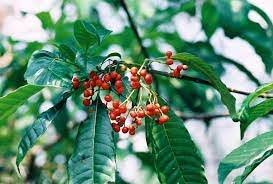
The African Snake Root
Names
- English: African Snake Root; Poison Devil’s Pepper
- Yoruba: Asofeyeje or Oruwo
- Igbo: Akanta or Ogbu oji
- Hausa: Tozalin gida; Wutacika; Chindar; Wada; Baba Mai Wada.
- Urhobo/Itsekiri: Okhue
- Edo: Erin
Health Benefits
- Antipsychotic and Sedative Properties: The plant’s root extracts have tranquilizing effects, traditionally used to treat mental disorders such as anxiety, insomnia, and schizophrenia.
- Antihypertensive Effects: Reserpine and other alkaloids lower blood pressure by depleting catecholamines, making it effective for managing hypertension.
- Antimicrobial Activity: Leaf and root extracts exhibit activity against pathogens like Staphylococcus aureus, Escherichia coli, and Candida albicans, supporting its use in treating infections, including sexually transmitted diseases.
- Antimalarial Potential: The plant shows in vitro activity against Plasmodium falciparum, validating its traditional use for malaria treatment.
- Antidiabetic Effects: Extracts from leaves and roots have demonstrated hypoglycemic effects in animal studies, aiding in blood sugar regulation.
- Anti-inflammatory and Analgesic Effects: The plant reduces inflammation and pain, used traditionally for conditions like arthritis and general body pain.
- Antioxidant Properties: Flavonoids and phenolic compounds in the leaves provide antioxidant benefits, protecting against oxidative stress-related diseases.
- Anticancer Potential: Some studies suggest that extracts from the root bark may have cytotoxic effects on cancer cells.
- Digestive Aid: It helps with stomach disorders and intestinal worms
Other Benefits
- Cultural and Spiritual Uses: In Nigeria, particularly among the Yoruba and Igbo, the plant is used in rituals and as a protective charm against spiritual ailments or “evil spirits.”
- Agricultural Pest Control: Leaf extracts have insect-repellent properties, used to protect crops from pests in traditional farming systems.
- Environmental Role: The shrub contributes to soil stabilization in forested areas and is often integrated into agroforestry systems, supporting biodiversity.
- Economic Potential: The plant’s alkaloids are of interest in pharmaceutical industries, providing income opportunities for communities involved in its harvesting and trade- Pest Control – Extracts used as natural insecticide
- Veterinary Use: It is sometimes used to treat parasitic infections and fevers in livestock.
- Fertility and Reproductive Health: In some traditions, it is believed to enhance fertility and treat menstrual irregularities.
- Wildlife Support: The fruits serve as food for birds and small mammals
- Ornamental Value: It is sometimes cultivated for its attractive foliage and berries
- Research Interest: It is a subject of numerous pharmacological studies
How It Is Used
- Medicinal Preparations:
- Root and leaf decoctions are used to treat hypertension, fever, and mental disorders.
- The bark is boiled for remedies addressing malaria, convulsions, and gastrointestinal issues.
- Dried root bark is ground into powder and sometimes mixed with other herbs for traditional remedies.
- In some local practices, the bark is chewed directly to treat toothache, mouth infections, or induce mild sedation.
- Topical Applications: Leaf extracts are applied to treat skin infections, snakebites, and wounds due to their antimicrobial and wound-healing properties.
- Sedative Use: Root infusions are administered to calm patients with anxiety or insomnia, often in combination with other herbs.
- Traditional Practices: The plant is used in ethnobotanical remedies for infertility, jaundice, and as a purgative. It is also chewed or boiled for oral administration in treating dysentery.
- Spiritual Uses: In traditional settings, the plant is incorporated into concoctions for spiritual cleansing or protection rituals.
Side Effects/Caution
- Toxicity: High doses of reserpine (present in the root bark) can cause adverse effects like depression, drowsiness, nasal congestion, and gastrointestinal upset. Overdose may lead to severe sexual dysfunction, hypotension or bradycardia.
- Central Nervous System Effects: Prolonged use may result in sedation, mental depression, or parkinsonism-like symptoms due to dopamine depletion.
- Contraindications: It should be avoided in patients with a history of depression, peptic ulcers, or during pregnancy, as reserpine may cross the placenta and affect the fetus. It should also be avoided during breast feeding.
- Drug Interactions: The plant may interact with antihypertensive drugs, monoamine oxidase inhibitors, or antidepressants, potentially exacerbating side effects.
- Allergic Reactions: Some individuals may experience allergic responses to the plant’s compounds, particularly when applied topically.
- Sustainability Concerns: Overharvesting of roots and bark threatens wild populations, necessitating sustainable cultivation practices.
- Medical Supervision: Due to its potent alkaloids, use should be guided by healthcare professionals, especially for internal consumption.
References
- Adotey, J.P.K., et al. “Antimalarial Activity of Rauvolfia vomitoria Root Extracts.” African Journal of Traditional Medicine, vol. 9, no. 3, 2012, pp. 386-391.
- Amole, O. O., et al. “Hypoglycemic and Hypolipidemic Activity of the Aqueous Leaf Extract of Rauvolfia vomitoria Afzel in Rats.” African Journal of Pharmacy and Pharmacology, vol. 6, no. 4, 2012, pp. 260–265, doi:10.5897/AJPP11.387.
- Ayinde, B. A., et al. “Cytotoxic and Antiproliferative Activities of Extracts from Rauvolfia vomitoria.” Journal of Pharmacognosy and Phytotherapy, vol. 2, no. 6, 2010, pp. 71–75.
- Burkill, H. M. “The Useful Plants of West Tropical Africa.” Royal Botanic Gardens, Kew, vol. 1, 1985, pp. 96–100.
- Ezeonu, C.S., and O.O. Onyekwelu. “Toxicological Profile of Rauvolfia vomitoria Extracts.” Phytotherapy Research, vol. 29, no. 4, 2015, pp. 500-508.
- Gill, L. S. “Ethnomedical Uses of Plants in Nigeria.” Uniben Press, 1992, pp. 165–167.
- Iwu, M.M. Handbook of African Medicinal Plants. 2nd ed., CRC Press, 2014, pp. 287-290.
- Iwu, Maurice M. Handbook of African Medicinal Plants. 2nd ed., CRC Press, 2014, pp. 297–299.
- Odugbemi, T. Outlines and Pictures of Medicinal Plants from Nigeria. University of Lagos Press, 2008, pp. 123–125.
- Okoli, C.O., et al. “Ethnomedicinal Uses of Rauvolfia vomitoria in African Traditional Medicine.” Journal of Ethnopharmacology, vol. 134, no. 1, 2011, pp. 83-91.
- Okwu, D. E., and J. Josiah. “Evaluation of the Chemical Composition of Two Nigerian Medicinal Plants.” African Journal of Biotechnology, vol. 5, no. 4, 2006, pp. 357–361.
- Okwu, D. E., and M. E. Okwu. “Chemical Composition of Rauvolfia vomitoria Afzel.” Journal of Chemical and Pharmaceutical Research, vol. 2, no. 4, 2010, pp. 139–144.
- Nworgu, Z. A. M., et al. “Effects of Ethanolic Extracts of Rauwolfia vomitoria on Blood Pressure and Heart Rate in Albino Rats.” African Journal of Biotechnology, vol. 7, no. 10, 2008, pp. 1335–1338.
- Pesewu, G. A., et al. “Antibacterial and Antifungal Activities of Rauvolfia vomitoria and Kigelia africana.” African Journal of Traditional, Complementary and Alternative Medicines, vol. 5, no. 3, 2008, pp. 235–243, doi:10.4314/ajtcam.v5i3.31283.
- Sofowora, A. Medicinal Plants and Traditional Medicine in Africa. Spectrum Books, 2008.
- Sonibare, M. A., et al. “Antimicrobial and Antioxidant Activities of Rauvolfia vomitoria Afzel.” Journal of Applied Pharmaceutical Science, vol. 3, no. 7, 2013, pp. 116–120, doi:10.7324/JAPS.2013.30718.
- World Health Organization. “WHO Monographs on Selected Medicinal Plants.” Vol. 2, WHO Press, 2004, pp. 295-306.