
Names:
- General: Mistletoe; Children matches.
- Hausa: Kauchi.
- Igbo: Ibu; Apari.
- Yoruba: Afomo onisanan.
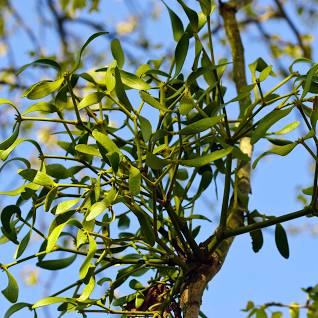
Description:
It is a hemi-parasitic, evergreen plant that grows on a wide variety of host trees such as guava, breadfruit, oak, apple, etc.; that belongs to the family Santalaceae. It carries out photosynthesis independently but obtains water and minerals from the host. It has thick, gristly leaves that are lance shaped or oval and grow in pairs. It has dense branches in oval shapes that are about 5cm long. Its flowers are small, white and made up of four tiny petals which form in clusters of three to five flowers are found in compact spikes, and are regular. The fruits are waxy berries that grow in clusters. The seeds inside are coated in a sticky substance which sticks to the beaks of birds feeding on the fruit.
After the seed germinates, a modified root (haustorium) penetrates the bark of the host tree and forms a connection through which water and nutrients pass from host to plant. They are slow-growing but persistent and their natural death is determined by the death of the hosts. Removal of the plant from the host is the only means of controlling the parasitic activities. There are hundreds of mistletoe species around the world.
Cultivation/Propagation
- Fruit-eating birds distribute the seeds in their droppings or by wiping their beaks, to which the seeds often adhere, against the bark of a tree.
- The seed germinates on the branch of a host tree or shrub, and in its early stages of development it is independent of its host.
Medicinal Benefits
- The injectable extract has been useful for the treatment of the following forms of cancer: breast cancer, advanced pancreatic cancer, colon cancer, bladder cancer, stomach cancer, liver cancer, leukemia, lung cancer, ovarian cancer, and uterine cancer.
- Possesses antihypertensive, anticancer, anti-inflammatory anticancer; antioxidant, analgesic, anti-inflammatory and immune-stimulatory properties.
- Used for the management of neurological disorders including nervousness/anxiety, convulsions, hysteria, neuralgia, depression and seizures.
- Useful for the management of respiratory disorders including asthma; common colds, sore throats, fevers, and coughs.
- Used for the management of cardiovascular disorders; Stroke; and Diabetes.
- Used topically for skin diseases like varicose veins, eczema, leg ulcers.
- Used for the treatment of headaches; arthritis symptoms; and cancer.
- It is used as a natural aphrodisiac and to promote fertility.
- Prevents oxidative stress and DNA damage.
- Promotes good sleep and treats snoring.
- Prevents miscarriage during pregnancy.
- Treatment of urinary tract disorders.
- Improves bone and teeth health.
- Supports hormone balance.
- Eases menstrual disorders.
- Boost immune system.
Other Benefits:
- Mistletoe holds a significant place in European folklore and traditions, especially during the Christmas season. It is often hung in homes as a symbol of peace and goodwill, and it is associated with the custom of kissing under the mistletoe.
- It is associated with peace, protection, romance and celebration.
- In some cultures, it is a symbol of protection from misfortune, and believed to ward off evil spirits.
How it is used:
- The tea is made with the pulverized dried plant infused in hot or cold water at a recommended dose of 10g per day (1-2 teaspoons in a cup of boiling water; taken 3 times daily). It is taken for the following conditions:
- Hypertension; Cardiovascular disorders; and Respiratory diseases.
- Management of Cancers; Diabetes
- Management of neurological disorders;
- Management and prevention of oxidative stress;
- Mistletoe tincture is made by infusing 50g of the powder in 200ml of 70% alcohol and allowed to steep for at least 48 hours. The tincture is used as follows:
- Inhaled for the treatment of Respiratory disorders; headaches; and fever.
- 2ml is diluted in water or drink and taken up to 3 times a day for the treatment of disease conditions mentioned above.
- The powdered dried plant is infused in oil (like coconut or olive oil) and applied to the skin for the treatment of varicose veins, eczema, and leg ulcers. It is also used to improve skin health and treat skin inflammation.
- To defend against respiratory issues and colds, sprigs of mistletoe can be used to make herbal tea/tinctures or they can be inhaled.
- It is dried and extracted to make injections; it is taken orally as capsules; teas and made into tinctures.
- The leaves and twigs are soaked in water and used for bathing for treatment of generalized skin diseases.
Reported Side Effects/Caution:
- The berries are toxic if ingested, especially in large quantities. Symptoms of poisoning may include nausea, vomiting, diarrhea, stomach ache, stomach bloating, lose appetite and in severe cases, cardiovascular and nervous system complications. It is crucial to keep the berries out of reach of children and pets.
- It should be taken with caution in persons who are already on medications for the treatment of diabetes; heart disease; and hypertension.
- It should be avoided by the following:
- Persons who are taking MAO inhibitor medication like an antidepressant.
- Persons who have autoimmune disease conditions including allergies.
- Pregnant women and children.