
Names:
- General: Soursop, Chop chop
- Hausa: fasadarur or tuwon biri
- Igbo: Ogbakanti or sawansop
- Yoruba: Samsam, ebo or apekan
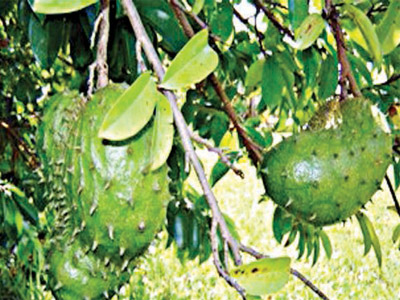
Description:
It is a tropical, evergreen plant species belonging to family Annonaceae. It grows upright and can grow up to 10m tall. Its young branches are hairy, the leaves are oblong to oval, glossy dark green with no hairs above, and paler and minutely hairy to no hairs below. The leaf stalks are without hairs. The flower stalks (peduncles) are woody, they appear opposite from the leaves. Stalks for the individual flowers (pedicels) are stout and woody, minutely hairy to hairless with small bractlets nearer to the base which are densely hairy. The petals are thick and yellowish. Outer petals meet at the edges without overlapping and are broadly ovate, tapering to a point with a heart shaped base. They are evenly thick, and are covered with long, slender, soft hairs externally and matted finely with soft hairs within. Inner petals are oval shaped and overlap. They are sharply angled and tapering at the base. The margins are comparatively thin, with fine matted soft hairs on both sides. The receptacle is conical and hairy. The stamens are narrowly wedge-shaped. The connective-tip terminate abruptly and anther hollows are unequal. Sepals are quite thick and do not overlap. Carpels are linear and basally growing from one base. Its pollen is shed as permanent tetrads. The fruits are large, heart-shaped, ridged on the outside, dark green but turns slightly light green as it ripens. They are ovoid, with a moderately firm texture. Their flesh is juicy, sour-acidic, whitish and aromatic. The fruit may contain up to 100 dark-coloured seeds.
Cultivation/Propagation
- The seeds are used for propagation. Cuttings and budding are also used to propagate the plant.
Medicinal Benefits
- It has a broad-spectrum antimicrobial, antispasmodic, anti-diabetic, antioxidant, antihypertensive, analgesic, anti-aging, anti-inflammatory, astringent, cardio tonic, diuretic, emetic, galactagogue, immunity boosting, laxative, liver tonic, and sedative activities.
- Thins mucus secretions, relieve throat irritation and even act as a mild expectorant, soothing many associated symptoms.
- Improves eye health (The antioxidants in the fruit vitamins C and E, zinc, and beta-carotene, decrease the risk of eye disease.)
- Used as treatment for fever, respiratory illness, malaria, gastrointestinal problems, liver, heart and kidney affections.
- and cancer treatment purposes.
- Improves mental, kidney, liver, gastrointestinal, and respiratory health
- Promotes weight loss
Other Benefits:
- The fresh leaves and unripe fruit are infused into oil (olive or coconut) and used externally for massaging in cases of arthritic/rheumatic pains, gout and neuralgia.
- The fruit’s creamy texture makes it perfect for making juices, smoothies, milkshakes, beverages, ice cream, and other sweet foods.
- The aqueous extract of the plant parts is used for the control of lepidopteran larvae, aphids and thrips, among others.
- The seeds when pulverized, can be used as skin astringents to treat body wrinkles and ageing lines on the body.
- Unripe fruit, seeds, leaves and roots are also used as biopesticides, bioinsecticides and topical insect repellents.
How it is Used:
- The decoction of the leaves and the bark/roots taken one cup two times daily or 6g of the capsulated powdered leaf taken in 3 or 4 divided doses is used the following:
- Treatment of digestive disorders like constipation, indigestion, diarrhea, dyspepsia, and peptic ulcers.
- Treatment of heart disorders, palpitation, hypertension, insomnia, nervousness, cancer, and anemia.
- Treatment of upper respiratory disorders like cough, colds, flu, bronchitis and asthma.
- Treatment of nervous disorders, nervousness, and insomnia.
- Treatment of malaria, parasitic infections, and stomachache.
- Used as bath water for skin infections and ailments.
- Treatment cystitis, bacterial and fungal infections.
- Treatment of liver and gallbladders disorders.
- Treatment of jaundice, and convulsions
- Treatment of hypercholesterolemia
- Treatment of menstrual disorders.
- Treatment of fever and pain.
- · The leaves are applied locally on pain site to relieve pain, treat cutaneous (external) parasites and heal wounds.
- The crushed seeds are used for the for expelling worms and intestinal parasites.
· The ethanol leaf extract is used for the following:
o Management of depression and associated disorders.
o Management of anxiety disorders and stress.
- The fruit is eaten as a natural medicine for:
- Diarrhea, dysentery, fever, malaria, parasitic infections and worm infestation.
- Heart diseases, liver diseases and to eliminate intestinal parasites.
- Improvement of milk flow after child birth.
- Arthritic pain, neuralgia, and arthritis.
- Rheumatism and skin rashes.
Reported Side Effects/Caution:
- There is no recorded drug interaction, however those taking prescription antidiabetic, antihypertensive and antidepressants drugs should take it with caution or seek physician advice as soursop potentiates the activity of these drugs.
- High doses of the infusion (tea) or decoction may cause nausea and vomiting especially in those prone to allergic reactions.
- It is not advisable to ingest soursop seed and bark as they can lead to or promote Parkinson’s disease.
- It has uterine stimulant property and should be avoided during pregnancy.
References:
- https://en.wikipedia.org/wiki/Soursop
- https://www.stylecraze.com/articles/benefits-of-soursop-for-skin-hair-and-health/
- https://www.healthline.com/nutrition/soursop-benefits#TOC_TITLE_HDR_8
- https://www.ncbi.nlm.nih.gov/pmc/articles/PMC5862046/
- https://guardian.ng/features/the-healing-values-of-soursop/
- https://pharmanewsonline.com/soursop-magic-fruit/
- https://www.ncbi.nlm.nih.gov/pmc/articles/PMC4519917/