
Description
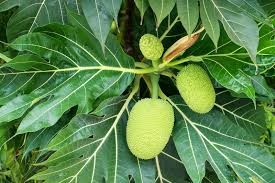
Artocarpus altilis (Parkinson) Fosberg, commonly known as breadfruit, is a large, evergreen tree species in the mulberry family Moraceae (the same family as figs, jackfruit, and African breadfruit). The genus name Artocarpus is derived from the Greek words artos (bread) and karpos (fruit), referring to the starchy, bread-like texture of the cooked fruit.
Morphology: The tree is fast-growing and typically reaches 10–30 meters (30–100 feet) in height, with a trunk diameter ranging between 60 and 120 cm. The trunk is usually unbranched for the first 4 meters or more, after which it produces spreading branches that form a dense, rounded canopy. The bark is smooth and greyish-brown.
Leaves: The leaves are among the most distinctive features of the breadfruit tree. They are large, alternate, and ovate to elliptical in shape, measuring 20–60 cm in length and 20–40 cm in width. When young, the leaves are entire (undivided) and often deeply lobed. As the tree matures, the leaves become thick, leathery, and deeply pinnately cut into pointed lobes. The upper surface is dark green and glossy, while the lower surface is pale green and rough to the touch. The petioles (leaf stalks) are 3–5 cm long.
Flowers: The tree is monoecious, meaning both male and female flowers are borne on the same plant but on separate inflorescences. The inflorescences are axillary (growing from the leaf axils) on peduncles (stalks) measuring 4–8 cm long.
- Male inflorescences: These are drooping, club-shaped structures measuring 15–25 cm in length and 3–4 cm in diameter, yellow in color, with minute flowers each containing a single stamen.
- Female inflorescences: These are upright, globose or cylindrical, measuring 8–10 cm in length and 5–7 cm in diameter, green in color, with numerous flowers embedded in the receptacle.
Fruit: The fruit is a large, compound syncarp (a cluster of fused fruits formed from the entire female inflorescence) . It is cylindrical to globose in shape, measuring 10–30 cm (4–12 inches) in diameter and weighing up to 4 kg (9 pounds) or more. The rind is yellow-green when ripe, with a reticulated pattern marked by 4-6-sided faces. The rind may be smooth or rough-skinned depending on the variety. A large central core runs through the fruit, surrounded by numerous abortive flowers that form the pale yellow, juicy, creamy-white pulp—this is the edible portion.
Seeds: Cultivated breadfruit varieties are typically seedless (parthenocarpic), as they have been selected over centuries for their fleshy pulp and absence of seeds. However, some wild or less domesticated varieties (sometimes distinguished as Artocarpus altilis var. seminifera) do contain seeds that are edible and nutritious.
Latex: All parts of the tree are rich in white, gummy latex, which has various traditional and practical applications.
Origin and Distribution: Breadfruit is native to Malaysia, the South Pacific islands (Melanesia, Micronesia, Polynesia), and the Philippines. It has been cultivated for over 3,000 years by Pacific Islanders, who developed numerous seedless varieties through vegetative propagation. The tree was famously transported by Captain William Bligh on HMS Bounty in the late 18th century from Tahiti to the West Indies, where it was introduced as a cheap, high-energy food source for enslaved workers on British plantations. Today, breadfruit is widely cultivated throughout the tropics, including the Caribbean, Central and South America, Africa (including Nigeria), India, Southeast Asia, and Hawaii.
Varieties: There are dozens, possibly hundreds, of breadfruit varieties. Captain Cook documented nine varieties in the Fiji Islands, and twenty varieties in the Samoan Islands. Wilkes similarly documented twenty varieties. In Tahiti alone, there are eight seedless varieties and one seeded variety. The seedless varieties are preferred for culinary use due to their higher pulp content and easier preparation.
Common Names
- English: Breadfruit
- French: Arbre à pain
- German: Brotfruchtbaum
- Spanish: Árbol del pan
- Portuguese: Fruta-pão
- Dutch: Broodvrucht
- Chinese: 面包树 (Miànbāo shù)
- Yoruba: Eso burẹdi; Gbere, Bere fruit, Epa Oyinbo, Jaloke
- Hausa: Jada
- Igbo: Ukwa Oyibo; Ukwa bekee
Health Benefits
Artocarpus altilis is highly valued not only as a staple food crop but also for its numerous nutritional and medicinal properties. Breadfruit is an important source of significant nutrients and palatable foods and can play a role in sustainable agriculture and food security. The fruits and seeds are good sources of carbohydrates, protein, dietary fiber, fatty acids, pro-vitamin A, potassium, and calcium, with significant amounts of ascorbic acid (vitamin C), niacin, and iron.
- Nutritional Composition: Breadfruit is a nutrient-dense food, particularly rich in complex carbohydrates, dietary fiber, and essential minerals.
Proximate Composition (per 100g of raw breadfruit pulp):
| Component | Approximate Content |
| Carbohydrates | 27–30 g |
| Protein | 1.3–1.5 g |
| Fat | 0.2–0.4 g |
| Dietary Fiber | 4–5 g |
| Vitamin C | 20–30 mg |
| Potassium | 400–500 mg |
| Calcium | 20–30 mg |
| Magnesium | 20–30 mg |
| Iron | 0.5–0.6 mg |
Data from USDA and nutritional studies
Breadfruit is especially rich in potassium, which supports heart health and blood pressure regulation. The dietary fiber content promotes digestive health and helps maintain healthy cholesterol levels. The vitamin C content supports immune function and collagen synthesis.
Research has also identified the presence of linoleic acid and linolenic acid (essential fatty acids) in breadfruit. The protein fraction from breadfruit pulp has been shown to exhibit antioxidant properties. The amount of different minerals found in breadfruit varies greatly depending on the cultivar and growth area; these minerals include copper, magnesium, phosphorus, potassium, calcium, cobalt, iron, and manganese.
- Antioxidant Properties: Breadfruit contains various phenolic compounds, including flavonoids and prenylated phenolic compounds such as geranylated flavones, which exhibit antioxidant activity. Antioxidants neutralize free radicals, reduce oxidative stress, and help prevent chronic diseases including cardiovascular disorders, cancer, and neurodegenerative conditions.
The protein fraction extracted from breadfruit pulp has demonstrated antioxidant properties and has been shown to reverse anxiety behavior in adult zebrafish via the serotoninergic system.
- Anti-inflammatory Effects: One of the most well-documented medicinal properties of breadfruit is its anti-inflammatory activity. The pharmacological studies have indicated that some flavonoids from breadfruit have anti-inflammatory activities and are able to inhibit 5-lipoxygenase of cultured mastocytoma cells, cathepsin K, and 5α-reductase . This supports the traditional use of breadfruit leaves and fruits for treating inflammatory conditions.
Additional research on Artocarpus altilis has confirmed a range of pharmacological activities including anti-inflammatory, antioxidant, antifungal, immunomodulatory, antidiabetic, and antibacterial effects.
- Antidiabetic (Blood Sugar Regulation) Properties: Breadfruit has demonstrated antidiabetic effects in pharmacological studies. While some traditional beliefs have cautioned that breadfruit is not recommended for diabetics due to its carbohydrate content, modern research suggests that the fiber and bioactive compounds in breadfruit may actually help regulate blood sugar absorption. The glycemic index of breadfruit is moderate (GI ≈ 55–65), and when consumed with protein or fat, its impact on blood sugar is further moderated.
- Cardiovascular Health (Blood Pressure and Cholesterol): The high potassium content (400–500 mg per 100g) makes breadfruit excellent for blood pressure regulation, as potassium helps counteract the effects of sodium and relaxes blood vessel walls. The dietary fiber content helps lower LDL (bad) cholesterol by binding bile acids and promoting their excretion.
In the Virgin Islands, breadfruit is taken for coronary ailments (heart disease) . The leaf decoction is used for high blood pressure in the West Indies.
- Digestive Health: The high dietary fiber content (4–5 g per 100g) promotes regular bowel movements, prevents constipation, and supports a healthy gut microbiome. The fiber also helps with weight management by promoting satiety.
- Immune System Support: The vitamin C content (20–30 mg per 100g) supports immune function by enhancing white blood cell activity and protecting against oxidative damage. The presence of various bioactive compounds also contributes to immunomodulatory effects.
- Skin Health and Wound Healing: Breadfruit has multiple traditional applications for skin conditions:
- In Brazil, fruits and leaves are used as a cataplasm for tumors
- In Costa Rica, latex is applied to wounds
- In Jamaica, latex is used to dress liver spots
- The latex is also applied to skin sores and cracked feet in various traditional medicine systems
- Antimicrobial and Antifungal Properties: Research has confirmed the antibacterial and antifungal activities of breadfruit extracts. These properties support traditional uses for treating infections and skin conditions.
- Essential Fatty Acids: Breadfruit contains adequate amounts of linoleic acid and linolenic acid (omega-6 and omega-3 fatty acids), which are essential for brain function, inflammation regulation, and cardiovascular health.
- Rich Amino Acid Profile: The protein fraction of breadfruit pulp contains 49.59% essential amino acids, including notable levels of lysine and leucine. Lysine is important for growth, tissue repair, and calcium absorption, while leucine plays a role in muscle protein synthesis and blood sugar regulation.
Other benefits
- Timber and Wood Products: The wood of breadfruit is light yellow, relatively light, and has a fine, even texture. It is suitable for furniture, carving, canoe building, and construction in some regions.
- Edible Seeds (Seeded Varieties): In seeded varieties (sometimes called breadnut), the seeds are edible and highly nutritious. They can be boiled or roasted and eaten like chestnuts. The seeds are a good source of protein and essential minerals.
- Livestock Feed: The fruit and leaves can be used as fodder for pigs, goats, and other livestock. Overripe or damaged fruits that are not suitable for human consumption can be fed to animals.
- Latex Uses: The white latex produced by the tree has multiple applications:
- As a birdlime (sticky substance to trap birds) in some Pacific islands
- As a chewing gum substitute
- As a waterproofing agent for boats and containers
- As a natural adhesive in traditional crafts
- Soil Improvement: The leaf litter of breadfruit trees decomposes and enriches the soil with organic matter, making it a good companion tree in agroforestry systems.
- Shade and Ornamental Use: The tree is often planted for its attractive, large lobed leaves and dense canopy, providing excellent shade in parks and large gardens in tropical regions.
- High Yield and Food Security: A mature breadfruit tree can yield between 400 and 2400 kg of breadfruit annually. Twenty-seven breadfruit trees, which would cover an English acre with their shade, are sufficient for the support of from ten to twelve people during the eight months of fruit-bearing. This productivity makes breadfruit a critical crop for food security in many tropical nations.
- Economic Importance: In Nigeria, breadfruit is an important non-wood forest product (NWFP) in the rainforest zone, particularly in states like Osun. Consumption patterns are determined by local availability and not dependent on levels of income. The perishable nature of the fruit, however, leads to high levels of wastage, requiring further research into preservation and value-added transformation.
- Propagation and Germplasm Conservation: Plant tissue culture techniques have allowed for mass clonal propagation, germplasm conservation and exchange, and improvement of crop species.
How it is used
Culinary uses (Nigerian and global context):
Preparation Before Cooking: The fruit must be cooked before eating, as it is starchy and unpalatable when raw. It must be roasted before it is eaten, and its taste is insipid, with a slight sweetness, somewhat resembling that of the crumb of wheaten bread mixed with a Jerusalem artichoke. Wilkes says the best varieties when baked or roasted are not unlike a good custard pudding.
Nigerian and West African Preparations:
- Boiled Breadfruit: The fruit is peeled, cut into chunks, and boiled in water (often salted) until tender. The cooked fruit has a potato-like texture and is eaten as a starchy side dish with stews, soups, or palm oil.
- Roasted Breadfruit: The whole fruit is roasted over charcoal or in an oven until the skin is charred and the inside is soft and fluffy. The skin is then peeled away, and the creamy flesh is eaten with butter, salt, or groundnut paste.
- Fried Breadfruit: Slices of peeled breadfruit are fried in oil (like fried plantains) until golden brown and crispy on the outside, soft on the inside.
- Breadfruit Chips: Thinly sliced breadfruit is deep-fried or baked to make crispy chips, a popular snack.
- Breadfruit Flour: Dried breadfruit can be ground into flour, which is gluten-free and can be used for baking bread, cakes, and other pastries. This flour has good functional and pasting properties.
- Pounded Breadfruit: Pounded into “Iyan Jaloke” (like pounded yam) and eaten with soups.
Global Culinary Uses:
- Pacific Islands (Traditional Preservation): If the breadfruit is to be preserved, it is scraped from the rind and buried in a pit where it is allowed to ferment, when it subsides into a mass somewhat of the consistency of new cheese. These pits when opened emit a nauseous, fetid, sour odor, and the color of the contents is a greenish-yellow. In this state it is called mandraiuta, or native bread, of which several kinds are distinguished. It is said that it will keep several years and is cooked with coconut milk, in which state it forms an agreeable and nutritious food.
- Caribbean: Breadfruit is used in soups, stews, and as a side dish. “Breadfruit oil down” is a national dish of Grenada. In Colombia, the fruit is cooked with sugar for colic.
- Hawaii: Breadfruit (ulu) is baked, boiled, fried, or made into chips and desserts.
- Southeast Asia: In Indonesia and Malaysia, breadfruit is often made into kolak (a sweet dessert cooked in coconut milk and palm sugar) or fried as gado-gado topping.
Traditional medicinal uses:
Breadfruit has extensive applications in traditional medicine across the tropics:
| Condition | Plant Part Used | Preparation Method |
| High blood pressure | Leaves | Leaf decoction (boiled in water), taken orally |
| Coronary ailments | Whole plant | Various preparations in the Virgin Islands |
| Tumors | Fruits and leaves | Used as a cataplasm (poultice) in Brazil |
| Wounds | Latex | Applied topically in Costa Rica |
| Liver spots | Latex | Dressed on spots in Jamaica |
| Colic | Fruit | Cooked with sugar and consumed in Colombia |
| Skin sores | Latex or leaf extract | Applied topically |
| Toothache | Latex | Applied directly to the affected tooth |
| Asthma | Leaf extract | Consumed as a decoction |
| Diarrhea | Bark or leaf decoction | Taken orally |
Other traditional uses:
- Antidiabetic: Leaf extracts are used traditionally to help manage blood sugar levels .
- Anti-inflammatory: Leaf poultices are applied to swollen joints and inflammations.
- Febrifuge (fever reducer): Leaf decoctions are used to reduce fever.
Preparation methods summary:
- Decoction: Plant parts (leaves, bark) are boiled in water, and the resulting liquid is consumed orally.
- Topical application: Latex, crushed leaves, or fruit paste is applied directly to the skin for wounds, sores, or inflammations.
- Cataplasm (poultice): Mashed fruits or leaves are applied as a soft, moist mass to inflamed or injured body parts.
Side Effects / Caution
- General Safety Profile (Favorable): Multiple toxicity studies have demonstrated that Artocarpus altilis has a favorable safety profile when used appropriately.
Acute Toxicity:
- LD50 > 10,000 mg/kg in rats (ethanol extract of leaves), indicating that the extract is practically non-toxic. This is an extremely high LD50 value, suggesting a very wide margin of safety.
Subchronic Toxicity (28-day study):
- The ethanol extract of A. altilis leaves at doses up to 400 mg/kg showed no toxic effects on hematology or serum biochemistry in rats.
- However, at the highest dose of 400 mg/kg BW, the subchronic toxicity study revealed changes in the liver index and histology, although these did not affect the biochemical parameters of the organ.
- The study concluded that the ethanol extract of A. altilis leaves at doses ≤ 400 mg/kg showed no toxicity in the subchronic phase, supporting its safety as a herbal medicine candidate.
- Mild Adverse Reactions: Some individuals may experience mild digestive discomfort when consuming large quantities of breadfruit, particularly if they are not accustomed to high-fiber foods. Symptoms may include bloating, flatulence, or mild diarrhea.
- Latex Sensitivity and Contact Dermatitis: The white latex of the breadfruit tree can cause skin irritation or contact dermatitis in sensitive individuals. When harvesting or preparing the fruit, it is advisable to wash hands thoroughly after handling, as the latex can be sticky and may cause mild irritation.
- Drug Interactions: Given the plant’s documented antihypertensive (blood pressure-lowering) and antidiabetic properties:
- Antihypertensive medications: May have additive effects with blood pressure medications. Individuals on such medications should consult a healthcare provider before using therapeutic amounts of breadfruit leaf extracts.
- Antidiabetic medications: May have additive blood sugar-lowering effects. Diabetics should monitor their blood glucose levels when consuming breadfruit therapeutically, particularly in extract form.
- Pregnancy and Lactation:
- No specific safety data is available for medicinal use during pregnancy and breastfeeding.
- Dietary consumption of the fruit as food is generally considered safe, but medicinal use of concentrated leaf extracts should be avoided during pregnancy and lactation unless under professional supervision.
- Dietary Considerations (Diabetes and Carbohydrate Content): Breadfruit is high in carbohydrates (approximately 27–30 g per 100g). While its glycemic index is moderate (GI ≈ 55–65), diabetics should be mindful of portion sizes and pair breadfruit with protein or fat sources to moderate blood sugar response. Some traditional beliefs have cautioned that breadfruit is not recommended for diabetics, but modern research suggests it can be included in moderation as part of a balanced diet.
- Perishability and Food Safety: Fresh breadfruit is highly perishable and spoils within a few days of harvest if not properly stored or processed. Spoiled fruit can develop mold or bacterial growth and should not be consumed. Proper preservation methods (freezing, drying, canning, or fermentation) should be employed for storage.
- Allergic Reactions: As a member of the Moraceae family (which includes figs and mulberries), rare allergic reactions are possible, particularly in individuals with known allergies to other members of this family.
- Moderation: As with any food containing bioactive compounds, moderation is recommended, especially for individuals with pre-existing medical conditions.
References
“Artocarpus Altilis (Parkins.) Fosb. (Moraceae) — Breadfruit, Breadnut, Pana.” CRC Handbook of Medicinal Herbs, by James A. Duke, CRC Press, 1985. Taylor & Francis, doi:10.1201/9781351071130-12.
“Artocarpus altilis (Parkinson) Fosberg.” Finnish Biodiversity Info Facility, laji.fi/en/taxon/MX.5009477. Accessed 18 May 2026.
“Artocarpus altilis (Parkinson) Fosberg.” Pl@ntUse, plantuse.plantnet.org/en/Artocarpus_altilis. Accessed 18 May 2026.
“Artocarpus altilis (Parkinson) Fosberg.” Plants of the World Online, Royal Botanic Gardens Kew, powo.science.kew.org/taxon/urn:lsid:ipni.org:names:850129-1. Accessed 18 May 2026.
“面包树 (Artocarpus altilis).” 在线中国植物志 (Online Flora of China), www.cn-flora.ac.cn. Accessed 18 May 2026.
“Artocarpus Altilis (Breadfruit).” *Gardenia.net*.
“Artocarpus Altilis.” *Tropical Plants Database*, tropical.theferns.info/viewtropical.php?id=Artocarpus+altilis. Accessed 18 May 2026.
Badrie, Neela, and Joanne Broomes. “Beneficial Uses of Breadfruit (Artocarpus altilis): Nutritional, Medicinal and Other Uses.” Bioactive Foods in Promoting Health: Fruits and Vegetables, edited by Ronald Ross Watson and Victor R. Preedy, Academic Press, 2010, pp. 491-505. ScienceDirect, doi:10.1016/B978-0-12-374628-3.00033-5.
Fitrya, Fitrya, et al. “Safety Evaluation of Ethanol Extract from Artocarpus altilis Leaves as a Herbal Medicine Candidate: Studies in Acute and Subchronic Toxicity.” Phytomedicine Plus, vol. 5, no. 1, 2025, p. 100696. Ovid, doi:10.1016/j.phyplu.2024.100696.
Jones, A. M., et al. “Nutritional and Health Benefits of Breadfruit (Artocarpus altilis).” Foods, vol. 10, no. 7, 2021, pp. 1–18.
Mehta, K. A., et al. “Breadfruit (*Artocarpus Altilis*): Processing, Nutritional Quality, and Traditional Uses.” *PMC*, 2023. (Full citation based on PMC article PMC10061028).
Morton, Julia F. Fruits of Warm Climates. Creative Resource Systems, 1987.
Nwokolo, E. “African Breadfruit (*Treculia Africana* Decne) and Polynesian Breadfruit (*Artocarpus Altilis* Fosberg).” Comparative studies (as referenced in ethnobotanical reviews).
Ojimelukwe, Philippa C., and Florence U. Ugwuona. “The Traditional and Medicinal Use of African Breadfruit (*Treculia Africana* Decne)…” *Journal of Ethnic Foods*, vol. 8, no. 21, 2021. (Distinguishes the two species).
Popoola, Labode, et al. “Marketing and Utilization of Artocarpus altilis (Parkinson) Forsberg in the Rainforest Area of Osun State, Nigeria.” Funaab Series A: Agricultural Sciences, Federal University of Agriculture, Abeokuta, 2002.
Ragone, Diane. “Artocarpus altilis (Breadfruit).” Species Profiles for Pacific Island Agroforestry, Permanent Agriculture Resources (PAR), 2006.
Ragone, Diane. Breadfruit: Artocarpus altilis (Parkinson) Fosberg. International Plant Genetic Resources Institute, 1997.
Rashid, F., et al. “Breadfruit: An Underutilized Tropical Fruit with High Nutritional Value.” International Food Research Journal, vol. 22, no. 2, 2015, pp. 695–700.
Roberts-Nkrumah, L. B. “Breadfruit Production and Utilization.” Acta Horticulturae, vol. 757, 2007, pp. 201–208.
Sikarwar, M. S., et al. “A Review on *Artocarpus Altilis* (Parkinson) Fosberg (Breadfruit).” *Journal of Applied Pharmaceutical Science*, vol. 4, no. 08, 2014, pp. 091–097.
Verma, Ruchi, et al. “The Nutritional Aspects and Food Applications of Artocarpus altilis Starch: A Review.” International Journal of Science and Research Archive, vol. 12, no. 1, 2024, pp. 1234-1245. Semantic Scholar, doi:10.30574/ijsra.2024.12.1.0123.
WebMD. “Breadfruit – Uses, Side Effects, and More.” WebMD.com. Accessed 18 May 2026.