
Description
Artocarpus heterophyllus Lam., commonly known as jackfruit, is a large, evergreen tree species in the mulberry family Moraceae (the same family as figs, breadfruit, and African breadfruit). It produces the largest tree-borne fruits in the world.
Morphology: The tree is medium to large, typically growing 10–20 meters (30–65 feet) in height, with a trunk diameter of 30–50 cm (12–20 inches). Older trees often develop buttress roots. The bark is thick and blackish-brown. Young branchlets measure 2–6 mm in diameter and are glabrous (smooth) with longitudinal wrinkles.
Leaves: The leaves are leathery (coriaceous), arranged spirally, and are elliptical or obovate in shape, measuring 7–15 cm (sometimes longer) in length and 3–7 cm in width. The leaf apex is blunt or gradually pointed, while the base is wedge-shaped (cuneate). Mature leaves are entire (smooth-edged), but leaves on young trees and sprouts are often lobed. The upper surface is dark green and glossy, while the lower surface is pale green and slightly rough. The leaf tissue contains spherical or oval resin cells. The petiole (leaf stalk) is 1–3 cm long, and the stipules (leaf-like appendages at the base) are ovate, measuring 1.5–8 cm, and are shed early.
Flowers: The tree is monoecious, meaning both male and female flowers are borne on the same tree but separately. The inflorescences (flower clusters) emerge from the main trunk (cauliflory) or from older branches.
– Male inflorescences: These are cylindrical or club-shaped to ellipsoid, measuring 2–7 cm in length and up to 2 cm in diameter. They are covered with numerous tiny flowers, each with a single stamen. Male flowers typically appear first and are usually found at the tips of branches or in leaf axils.
– Female inflorescences: These are larger, roughly spherical or ellipsoid, and are typically borne on short, thick peduncles (stalks) emerging from the trunk or main branches. They develop into the massive fruit.
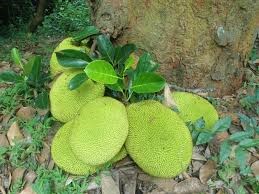
Fruit: The fruit is a massive, compound syncarp (a cluster of fused fruits derived from the entire female inflorescence). It is ellipsoidal to spherical, or irregular in shape, measuring 30–100 cm (12–40 inches) in length and 25–50 cm (10–20 inches) in diameter. Mature fruits can weigh anywhere from 10 to 45 kg (22 to 100 pounds). The rind is yellow-brown when ripe and is covered with hard, hexagonal, cone-like spikes or tubercles. The interior consists of a central, fibrous, inedible core surrounded by numerous individual “bulbs” or “arils,” which are the fleshy, edible parts. Each bulb contains a single, large, ellipsoidal seed (achene), measuring about 3 cm in length and 1.5–2 cm in diameter. The seeds are smooth and brown. Unripe fruits are green and produce a sticky, white latex when cut.
Origin and Distribution: Jackfruit is native to the rainforests of the Western Ghats of India and is also indigenous to Bangladesh, Malaysia, and other parts of Southeast Asia. It is the national fruit of Bangladesh. Today, it is widely cultivated throughout the tropical and subtropical regions of the world, including Southeast Asia, the Caribbean, East Africa (including Nigeria), and Brazil . In Nigeria, it is grown in the southern rainforest zones.
Common Names
- English: Jackfruit, Jack tree, Jacquier
- French: Jacquier
- German: Jackfruchtbaum
- Spanish: Jaca, Árbol del pan
- Portuguese: Jaca, Jaca-dura, Jaca-mole
- Chinese: 波罗蜜 (Bōluó mì)
- Yoruba: (Not traditionally native; occasionally called “Jackfruitu” or by the English name)
- Igbo: (Often referred to as “Jakfruut” or by the English name)
- India (Hindi): Kathal, Chakki, Panas
- Bangladesh (Bengali): Kanthal
- Thailand: Khanun
- Vietnam: Mít
- Sri Lanka (Sinhala): Kos
Health Benefits
Artocarpus heterophyllus is highly valued not only as a food source but also for its numerous medicinal properties. Every part of the tree—bark, roots, leaves, flowers, fruit pulp, and seeds—has been used in traditional medicine systems for centuries . Modern research has validated many of these traditional uses, demonstrating antioxidant, anti-inflammatory, antimicrobial, antidiabetic, antineoplastic, and wound-healing properties.
- Nutritional Composition: Jackfruit is a nutrient-dense food, often referred to as “poor man’s food” in some regions because it is cheap, plentiful during the summer, and provides a rich source of essential nutrients. A 2023 study from Nigeria analyzed the nutrient composition of jackfruit leaves, pulp, and seeds.
Proximate Composition (per 100g):
| Component | Pulp | Seeds | Leaves |
| Crude Protein | – | – | 19.25±0.62% |
| Carbohydrates | – | – | 30.41±0.31% |
| Crude Fiber | – | – | 4.18±0.03% |
| Ash (mineral content) | – | – | 4.13±0.06% |
Data from Umennadi et al., 2023
Mineral Content (per 100g):
| Mineral | Pulp | Seeds | Leaves |
| Potassium (K) | 2880.82±118.10 mg | – | – |
| Calcium (Ca) | – | – | 141.18±3.49 mg |
| Iron (Fe) | – | – | 20.24±0.72 mg |
| Zinc (Zn) | – | – | 1830.59±86.34 mg |
| Manganese (Mn) | – | – | 80.33±2.01 mg |
Data from Umennadi et al., 2023
Flower Mineral Content (per 100g):
| Mineral | Content in Flowers |
| Calcium (Ca) | 25.35±0.81 mg |
| Potassium (K) | 214.56±4.68 mg |
| Phosphorus (P) | 19.63±0.05 mg |
| Iron (Fe) | 196.36±8.32 μg/100g |
| Copper (Cu) | 106.62±5.21 μg/100g |
| Zinc (Zn) | 320.22±6.85 μg/100g |
| Manganese (Mn) | 185.62±4.55 μg/100g |
Data from a 2020 NIH study
Vitamin Content: Jackfruit pulp is rich in vitamin C (5.40±0.40 mg/100g) and contains vitamin B complex (especially B6, niacin, folic acid, and riboflavin) .
- Antioxidant Properties: This is one of the most well-documented health benefits of jackfruit. A 2023 Nigerian study demonstrated that jackfruit leaves have exceptionally high antioxidant activity.
Key findings:
- Flavonoid content: Leaves (3.10±0.13 mg/100g) > pulp (1.35 mg/100g) > seeds
- Tannin content: Leaves (7.61±0.27 mg/TAE/100g)
- Alkaloid content: Leaves (0.48±0.01%) > pulp (0.38%)
- DPPH radical scavenging activity: Reached an impressive 90.1% in leaf extracts
- FRAP assay (iron-reducing power): Leaves showed the highest activity
A separate 2020 study confirmed that jackfruit flowers contain high levels of total phenolics (883.20 μg GAE/g) and total flavonoids (658.52 μg QE/g), contributing significantly to their antioxidant potential. The study also noted that the flowers exhibit a high total carotenoid content (27.29 μg/g). The abundance of these phytochemicals suggests their potential health benefits in combating non-communicable diseases.
- Antidiabetic (Blood Sugar Regulation) Properties: Jackfruit has demonstrated significant antidiabetic effects in both preclinical and clinical studies.
Clinical evidence: Clinical studies have shown that a decoction of the leaves possesses hypoglycemic effects in both healthy individuals and non-insulin-dependent diabetic patients.
Mechanisms:
- The leaves and roots contain chemicals that may help control blood sugar increases after eating.
- The presence of flavonoids, sterols, and prenylflavones is believed to be responsible for the hypoglycemic activity.
Caution: Individuals taking diabetes medications should monitor their blood sugar closely, as jackfruit may have additive blood sugar-lowering effects.
- Anti-inflammatory Effects: The plant has demonstrated potent anti-inflammatory properties in preclinical studies. The flavonoids and other bioactive compounds are believed to be responsible for this activity. Traditional medicine systems have used various parts of the jackfruit tree to treat inflammation.
- Cardiovascular Health (Blood Pressure and Cholesterol): The high potassium content (2880 mg/100g in pulp, 214 mg/100g in flowers) makes jackfruit excellent for blood pressure regulation, as potassium helps counteract the effects of sodium and relaxes blood vessel walls. The dietary fiber and antioxidant compounds also support cardiovascular health by reducing oxidative stress and inflammation.
- Antimicrobial and Antibacterial Properties: Research has confirmed the broad-spectrum antimicrobial and antibacterial activities of jackfruit extracts. The crude methanolic extract of the stem and root barks, stem and root heartwood, leaves, fruits, and seeds exhibited antibacterial activity, with the butanol fractions of the root bark and fruits found to be most active. The plant also possesses anticariogenic (cavity-preventing) and antifungal properties.
- Anticancer (Antineoplastic) Properties: Jackfruit contains compounds with potential anticancer activity.
Jacalin: A compound isolated from jackfruit seeds, jacalin, has potential as a therapeutic agent for cancer. It has been used as a histochemical reagent to study tissue-binding properties in benign and malignant lesions of the breast and thyroid.
HIV research: Native jacalin, as well as a jacalin-derived peptide, has been found to prevent HIV-1 infection in vitro. However, the exact mechanism of action is not yet fully understood.
- Wound Healing Properties: Traditional medicine has used various parts of the jackfruit tree to treat wounds, ulcers, and other skin conditions. Preclinical studies have validated these wound-healing effects. Leaf ash has been applied to treat ulcers and wounds, while leaf extracts are used for their wound-healing properties.
- Digestive Health: The fiber content of jackfruit (both pulp and seeds) promotes regular bowel movements and supports gut health. The plant has also been used traditionally as a vermifuge (to expel parasitic worms) . The roots have been used in traditional medicine to treat diarrhea.
- Cooling Tonic and Fever Reduction: The pulp and seeds have been used traditionally as a cooling tonic, while the roots are used in treating fever. The plant possesses antipyretic (fever-reducing) properties.
- Lactation Aid (Galactagogue): The leaves have been used traditionally to activate milk supply in women and animals (acting as a galactagogue) . This traditional use has been documented in folk medicine systems.
- Anti-malarial Properties: Plants of the Artocarpus species, including A. heterophyllus, have been used as traditional folk medicine against malaria fever.
- Wound Healing and Skin Health: The latex and leaf extracts are applied topically to treat wounds, ulcers, and skin infections. The antimicrobial and anti-inflammatory properties contribute to these effects.
- Antifungal Properties: Research has documented antifungal activities of jackfruit extracts.
- Supports Eye Health: Vitamin A and antioxidant compounds help maintain healthy vision.
- Supports Bone Health: Minerals such as magnesium and calcium contribute to stronger bones and teeth.
Other benefits
- Timber and Wood Products: The heartwood of the jackfruit tree is very durable and is used in the preparation of furniture, doors, windows, and musical instruments. It is a valuable timber.
- Livestock Feed: The leaves and fruit waste (peels and seeds) are employed as feed for goats, cattle, and pigs.
- Fuel and Charcoal: The wood can be used as fuel and for producing charcoal.
- Soil Improvement and Erosion Control: The tree’s deep root system and leaf litter contribute to soil health and erosion control.
- Shade and Ornamental Use: The tree is often planted for its attractive, dense canopy, providing excellent shade in large gardens and parks.
- Industrial and Commercial Products: The latex has been used as an adhesive and for caulking boats. The wood pulp can be used for papermaking.
- Economic Importance: Jackfruit is a significant crop in many tropical countries. In Nigeria, it is an important non-wood forest product (NWFP) in the rainforest zones, providing income for rural communities. The fruit is often sold fresh in markets, and value-added products (dried chips, jam, jelly, candies, ice cream) are increasingly produced.
- Food Security: A mature jackfruit tree can yield between ten to two hundred fruits per year . This high productivity makes it a critical crop for food security, especially in regions where food scarcity occurs during the summer months .
- Superfood Trend: In Western nations, jackfruit has recently gained popularity as a meat alternative due to its meat-like texture when unripe, making it a sought-after “superfood” in vegan and vegetarian cuisine .
How it is used
Culinary uses (Nigerian and global context):
Ripe Fruit (Sweet):
- Fresh Consumption: The ripe, sweet, yellow bulbs are eaten fresh as a refreshing snack. In Nigeria, it is enjoyed on its own or as part of a fruit salad.
- Smoothies and Juices: The pulp is blended into smoothies, juices, and desserts.
- Ice Cream and Desserts: Ripe jackfruit is used to flavor ice cream, puddings, and other sweet dishes.
- Jams and Jellies: The pulp can be processed into jams, marmalades, and leathers.
Unripe Fruit (Savory – “Meat” Substitute):
- Curry: Unripe jackfruit (green) has a neutral flavor and a stringy, meat-like texture. It is cooked in savory curries and stews, absorbing the flavors of the spices . This is common in Southeast Asian and South Asian cuisines.
- Vegan “Pulled Pork”: In Western countries, young, unripe jackfruit is a popular plant-based meat substitute. It is often cooked with barbecue sauce to resemble pulled pork .
- Soup: Unripe jackfruit is added to soups as a vegetable.
Seeds:
- Boiled or Roasted: The seeds are boiled or roasted (like chestnuts) and eaten as a snack. They have a nutty, potato-like flavor.
- Curries: Boiled seeds can be added to curries.
- Ground into Flour: Dried and ground seeds can be used as a gluten-free flour for baking.
Jackfruit Flour:
- The pulp (ripe or unripe) can be dried and ground into flour, which is gluten-free and can be used for baking bread, cakes, and other pastries.
Jackfruit Chips:
- Thinly sliced unripe jackfruit is deep-fried or baked to make crispy chips, a popular snack.
Leaves and Flowers (Traditional):
- Flowers: In some traditional cuisines, the flowers are cooked and eaten as a vegetable .
- Leaves: Young leaves are sometimes cooked as a leafy vegetable.
Traditional medicinal uses (Nigeria and global context):
| Condition | Plant Part Used | Preparation Method |
| Diabetes | Leaves | Decoction (boiled in water), taken orally |
| Inflammation | Leaves, roots | Poultice or decoction |
| Wounds and ulcers | Leaf ash, latex | Applied topically |
| Fever | Roots | Decoction, taken orally |
| Diarrhea | Roots | Infusion or decoction, taken orally |
| Parasitic worms (vermicide) | Leaves | Infusion, taken orally |
| Skin infections | Latex | Applied topically |
| Toothache | Latex | Applied to the affected tooth |
| Abscesses | Latex | Applied topically to promote maturation |
| Asthma | Wood | Used as a sedative in convulsions |
| Boils | Latex | Applied topically |
| Malarial fever | Various parts | Decoction |
| Lack of breast milk | Leaves | Decoction taken to activate milk supply |
| Cancer | Seeds (jacalin extract) | Used as a therapeutic agent (research phase) |
Preparation methods summary:
- Decoction: Plant parts (leaves, roots, bark) are boiled in water, and the resulting liquid is consumed orally.
- Topical application: Latex, crushed leaves, or leaf ash is applied directly to the skin for wounds, ulcers, or skin infections.
- Poultice: Crushed plant material is applied as a soft, moist mass to inflamed or injured body parts.
Side Effects / Caution
- Latex-Fruit Syndrome (Cross-Reactivity with Latex Allergies) – Critical Safety Concern: This is the most significant safety concern associated with jackfruit consumption. Jackfruit is known to cross-react with latex allergens, a phenomenon called latex-fruit syndrome.
Key information:
- Prevalence: 30–50% of individuals with latex allergies have an associated hypersensitivity to some plant-derived food, especially fruit.
- Case reports: A 2023 case report documented a 68-year-old woman with a history of mild latex allergy who developed anaphylaxis (shortness of breath, tongue swelling, periorbital swelling, and extensive itchiness) within 30 minutes of ingesting only four pieces of jackfruit.
- Mechanism: The cross-reactivity is due to IgE antibodies that recognize similarly structured epitopes (protein sequences) in both latex and jackfruit. Several rubber latex allergen proteins (Hev b2, Hev b7, Hev b8, Hev b11, Hev b12) have been linked to cross-reactivity with various foods.
- Other cross-reactive foods: Avocado, banana, chestnut, kiwi, celery, pear, mango, and papaya.
Recommendation: Individuals with known latex allergy should avoid jackfruit or exercise extreme caution. This is particularly relevant for healthcare workers, who have higher rates of latex allergy due to occupational exposure. Anyone with a latex allergy should consult an allergist before consuming jackfruit.
- Allergic Reactions in Non-Latex Allergic Individuals: Even individuals without a known latex allergy may develop allergic reactions to jackfruit, though this appears to be rare. Symptoms may include hives, itching, oral allergy syndrome, and, in severe cases, anaphylaxis.
- Interaction with Diabetes Medications: Jackfruit may lower blood sugar levels. Taking jackfruit along with diabetes medications might cause blood sugar to drop too low (hypoglycemia) . Monitor your blood sugar closely if you have diabetes and consume jackfruit, especially in concentrated forms like leaf decoctions.
- Interaction with Blood Thinners (Anticoagulants / Antiplatelet Drugs): Jackfruit bark contains latex. This latex might slow blood clotting. Taking jackfruit latex along with medications that also slow blood clotting (e.g., warfarin, aspirin, clopidogrel) might increase the risk of bruising and bleeding . Moderate interaction – be cautious.
- Interaction with Sedative Medications (CNS Depressants): Jackfruit seeds might cause sleepiness and slowed breathing. Some medications, called sedatives (e.g., benzodiazepines, barbiturates, some sleep aids), can also cause sleepiness and slowed breathing. Taking jackfruit with sedative medications might cause breathing problems and/or excessive sleepiness. Moderate interaction – be cautious.
- Surgery (Anesthesia and Bleeding Risk): Jackfruit might cause bleeding and excessive drowsiness if combined with medications used during and after surgery. Stop taking jackfruit (especially in medicinal quantities) at least 2 weeks before scheduled surgery.
- Pregnancy and Breast-feeding: There isn’t enough reliable information to know if jackfruit is safe to use in medicinal quantities when pregnant or breast-feeding. Stay on the safe side and avoid medicinal use. Normal dietary consumption is generally considered safe.
- Antinutrient Content in Raw Seeds: Raw jackfruit seeds contain antinutritional compounds including phytic acid (0.30±0.04%) and oxalate (94.5±19.10 mg/100g) . These compounds can bind minerals and reduce their absorption. Proper processing (boiling, roasting, or fermentation) significantly reduces these antinutrients. Seeds should never be eaten raw.
- Gastrointestinal Effects from Excessive Consumption: The high fiber content of both pulp and seeds can cause bloating, flatulence, or mild diarrhea in individuals unaccustomed to high-fiber diets or those with irritable bowel syndrome (IBS). Moderation is advised.
- General Safety Profile (Relatively Favorable): Despite these precautions, extensive traditional use and modern research generally indicate that jackfruit is safe when consumed as food in normal quantities. The LD50 (acute toxicity) of leaf extracts has been shown to be very high (>10,000 mg/kg in rats), indicating a wide margin of safety. However, individuals with latex allergy should exercise particular caution.
References
Baliga, Manjeshwar Shrinath, et al. “Phytochemistry, Nutritional and Pharmacological Properties of Artocarpus heterophyllus Lam (Jackfruit): A Review.” Food Research International, vol. 44, no. 7, Aug. 2011, pp. 1800–1811. ScienceDirect, doi:10.1016/j.foodres.2011.02.035.
Orwa, C., et al. “Artocarpus heterophyllus Lam.” Agroforestree Database: A Tree Reference and Selection Guide, Version 4.0, 2009. Growables, www.growables.com/information/TropicalFruit/JackfruitAgroForest.htm.
“Artocarpus heterophyllus (Q45757).” Wikidata, www.wikidata.org/wiki/Q45757. Accessed 18 May 2026.
“Artocarpus heterophyllus Lam.” China Virtual Herbarium, Chinese Academy of Sciences, www.cvh.ac.cn/spms/detail.php?id=c4234176. Accessed 18 May 2026.
“Artocarpus heterophyllus Lam.” Plants of the World Online, Royal Botanic Gardens Kew, powo.science.kew.org/taxon/urn:lsid:ipni.org:names:850129-1.
“Jackfruit.” WebMD, www.webmd.com/vitamins/ai/ingredientmono-1487/jackfruit. Accessed 18 May 2026.
Khalid, Maria, et al. “Artocarpus heterophyllus Lam. Flowers: New Sources of Bioactive Compounds.” Plants, vol. 9, no. 10, Oct. 2020, p. 1329. PubMed Central, doi:10.3390/plants9101329.
Rahman, M. M., et al. “Use of Jackfruit (Artocarpus heterophyllus) Seeds in Health.” Nuts and Seeds in Health and Disease Prevention, edited by Victor R. Preedy et al., Academic Press, 2011, pp. 685-692. ScienceDirect, doi:10.1016/B978-0-12-375688-6.10079-9.
Umennadi, R. O., et al. “Comparative Studies on the Nutrient Composition and Antioxidant Activities of the Leaf, Pulp, and Seed Extracts of Jack-Fruit Tree (Artocarpus heterophyllus).” AGRIS, FAO, 2023, agris.fao.org/search/en/records/675aae130ce2cede71ccdce3.
Wong, K., et al. “Jackfruit Anaphylaxis Due to Cross Reactivity with Latex: A Case Report and Review of Literature.” Journal of Community Hospital Internal Medicine Perspectives, vol. 13, no. 4, 2023, pp. 42–44. PubMed Central, doi:10.55729/2000-9666.1199.
Baliga, M. S., et al. “Phytochemistry, Nutritional and Pharmacological Properties of Artocarpus heterophyllus Lam. (Jackfruit): A Review.” Food Research International, vol. 44, no. 7, 2011, pp. 1800–1811.
Morton, Julia F. Fruits of Warm Climates. Creative Resource Systems, 1987.
Ranasinghe, R. A. S. N., et al. “Nutritional and Health Benefits of Jackfruit.” International Journal of Food Science, vol. 2019, 2019, pp. 1–12.
Swami, S. B., et al. “Jackfruit and Its Many Functional Components as Related to Human Health.” Comprehensive Reviews in Food Science and Food Safety, vol. 11, no. 6, 2012, pp. 565–576.
Verheij, E. W. M., and R. E. Coronel, editors. Plant Resources of South-East Asia No. 2: Edible Fruits and Nuts. PROSEA Foundation, 1991.
Ranasinghe, Ruvini, et al. “Nutritional and Health Benefits of Jackfruit (*Artocarpus heterophyllus* Lam.): A Review.” *International Journal of Food Science*, vol. 2019, 2019, Article ID 4327183. PMC. (or equivalent citation).
“Jackfruit – Uses, Side Effects, and More.” *WebMD*, www.webmd.com/vitamins/ai/ingredientmono-1487/jackfruit. Accessed 18 May 2026.
“Jackfruit (*Artocarpus heterophyllus*).” *Feedipedia*, www.feedipedia.org/node/185. Accessed 18 May 2026.
Nansereko, S., and J. H. Muyonga. “Exploring the Potential of Jackfruit (*Artocarpus heterophyllus* Lam).” *African Journal of Food Science*, 2021. (or similar Nigerian/African ethnobotanical references).