
The Ancient Herb for Hair and Liver Health
Description
Tracing its medicinal use back thousands of years in Ayurveda, Eclipta prostrata is a powerful herb that has garnered global respect for its profound benefits, particularly for the liver and hair. Often found growing in wet, disturbed soils, this unassuming plant is a cornerstone of traditional medicine across Asia.
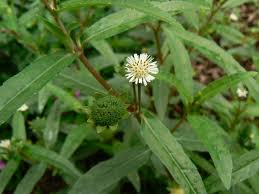
Eclipta prostrata, commonly known as false daisy, is an annual or perennial herbaceous plant in the Asteraceae family, native to tropical and subtropical regions worldwide, including Asia, Africa, Australia, and the Americas. It thrives in moist, disturbed habitats such as wetlands, marshes, and agricultural fields, often behaving as a weed. The plant grows to 20–80 cm, with prostrate or erect stems that are pubescent and root at nodes. Its leaves are opposite, lanceolate to ovate, 2–10 cm long, with serrated margins. The flower heads are small (6–8 mm in diameter), white or yellow, with ray and disc florets, and the fruits are achenes with a pappus of two short bristles. Eclipta prostrata is rich in bioactive compounds, including coumestans (e.g., wedelolactone), flavonoids, alkaloids, triterpenoids, and volatile oils, contributing to its pharmacological properties
Other Names
- English: False Daisy, Yerba de Tago, Trailing Eclipta
- Yoruba: Ewe epo, Oyin olobe
- Igbo: Anu-ukpo
- Hausa: Wufaga
- Sanskrit: Bhringraj, Kesharaja (“King of Hair”)
- Ayurvedic: Bhringaraj, Markav
- Chinese: Mo Han Lian (墨旱莲), Han Lian Cao
- Spanish: Yerba de Tajo, Hierba de la Eclipsa
- Brazil: Erva-botão, Agriação-do-brejo
Health Benefits
The therapeutic power of Eclipta prostrata is largely due to its complex chemistry, which includes coumestans (like wedelolactone), alkaloids (ecliptine), flavonoids, and triterpenoids. Its uses are vast and well-documented in both traditional and modern contexts.
- Hepatoprotective (Liver-Protecting): This is one of its most validated uses. Extracts, particularly wedelolactone, protect the liver from damage caused by toxins toxins like carbon tetrachloride and paracetamol, alcohol and chemicals, accelerate regeneration of liver cells, and are effective in treating hepatitis and jaundice.
- Hair Health and Growth: This is its most famous traditional use. Bhringraj is a primary ingredient in hair oils and tonics used to prevent hair loss, promote hair growth, combat premature graying, and strengthen hair follicles.
- Antioxidant Activity: The plant’s antioxidant properties, driven by high phenolic content (e.g., TPC up to 128.5 mg GAE/g). It is a potent scavenger of free radicals, helping to reduce oxidative stress linked to chronic diseases and aging.
- Anti-inflammatory and Analgesic Properties: It is used to reduce inflammation and relieve pain associated with conditions like arthritis, headaches, and reduces inflammation in conditions like dermatitis
- Antimicrobial Effects: Extracts have shown activity against various bacteria and fungi, supporting its use in treating skin infections and wounds.
- Gastrointestinal Aid: It is used to treat digestive issues like indigestion, constipation, and intestinal worms.
- Support for Respiratory Health: In some traditions, it is used to manage asthma and other respiratory conditions.
- Blood purification: Used traditionally to cleanse the blood and support skin health.
- Respiratory health: Helps manage asthma, cough, and bronchitis.
- Antidiabetic: Shown to reduce blood sugar levels in some studies.
- Other Health Benefits: It possesses antimalarial activity, anticancer potential against liver and breast cancer cell lines, and treatment of gastrointestinal issues (e.g., dysentery, diarrhea), respiratory conditions (e.g., asthma, cough), and urinary disorders
Other Benefits
Beyond its direct medicinal applications, Eclipta prostrata has other uses:
- Cosmetic Industry: It is a key ingredient in numerous commercial hair care products, including oils, shampoos, and conditioners, marketed for hair growth and health.
- Ethnobotanical Significance: The plant holds significant cultural value in Ayurveda and other traditional systems, where it is considered a premier rejuvenating (rasayana) herb.
- Ecological and agricultural applications: It serves as a natural pesticide, with extracts repelling insects like mosquitoes and termites due to volatile oils and terpenoids. It is also used in intercropping to suppress weeds and as green manure to enhance soil fertility, contributing nitrogen and organic matter
The plant supports ecological restoration in wetlands, stabilizing soil in disturbed areas
How It Is Used
All parts of the plant—leaves, roots, and stems—are used, often processed into various forms.
- Hair Oil (Bhringraj Tel): This is the most famous preparation. The fresh or dried plant is boiled in a carrier oil (like coconut or sesame oil) until the herbal properties are infused. This oil is massaged into the scalp for hair health or applied to the skin for inflammation.
- Juice: The fresh plant is crushed, and the juice is extracted. This is taken orally (often with honey) for liver disorders, jaundice, respiratory problems, and digestive problems.
- Powder (Churna): The dried plant is ground into a fine powder. This can be:
- Mixed with water, milk, or honey and consumed.
- Added to hair masks or pastes.
- Decoction (Kashayam): The plant is boiled in water to create a concentrated liquid medicine for internal use. Leaves and stems boiled in water and consumed for liver disorders, fever, or respiratory issues.
- Extracts: Extracts (aqueous, ethanolic, or methanolic) are used in modern formulations, such as tablets, capsules, or ointments, at doses like 100–400 mg/kg for specific effects in research settings
- Paste: Fresh leaves are ground into a paste and applied topically to the scalp for hair growth or on wounds and skin infections to promote healing.
Side Effects and Caution
Eclipta prostrata is generally considered safe for most people when used appropriately, with low toxicity in acute studies (LD50 > 2000 mg/kg in animals). However, some cautions are necessary.
- Pregnancy and Breastfeeding: Due to its potential effects on hormonal levels and the menstrual cycle, its use is not recommended during pregnancy or breastfeeding unless under strict medical supervision.
- Auto-immune Diseases: Because it may stimulate the immune system, there is a concern that it could increase symptoms of auto-immune diseases (such as multiple sclerosis, lupus, rheumatoid arthritis). Individuals with these conditions should avoid it.
- Allergy: Some individuals may experience an allergic reaction, especially when applied topically. A patch test is recommended before widespread use on the skin or scalp.
- Dosage: There is no universally standardized dose. Long-term, high-dose internal consumption should be monitored by a healthcare professional. Its hepatoprotective compounds may paradoxically cause liver stress at high doses due to alkaloid content
- Surgery: Because it might lower blood sugar, there is a theoretical risk of interfering with blood sugar control during and after surgery. It is advised to stop using it at least two weeks before a scheduled surgery.
- Drug Interaction: It may interact with medications metabolized by cytochrome P-450 enzymes, affecting drug efficacy, so consultation with healthcare providers is advised, especially for those on antidiabetic or antihypertensive drugs
References
- Dharmishtha, M., et al. Pharmacological and therapeutic potential of Eclipta alba (L.) Hassk: A review. International Journal of Pharmaceutical Sciences Review and Research, vol. 3, no. 1, 2010, pp. 50–52.
- Eclipta prostrata (L.) L. Plants of the World Online, Royal Botanic Gardens, Kew, www.plantsoftheworldonline.org/taxon/urn:lsid:ipni.org:names:201912-1. Accessed 5 Sept. 2025.
- Jadhav, Ankush N., et al. Development and Evaluation of Polyherbal Formulation for Hair Growth Activity. Journal of Cosmetic Dermatology, vol. 18, no. 6, 2019, pp. 1830-37.
- Jahan, Rownak, et al. Ethnomedicinal, Phytochemical and Pharmacological Profile of a Mangrove Plant Eclipta prostrata Linn. Journal of Complementary and Integrative Medicine, vol. 16, no. 2, 2019, doi:10.1515/jcim-2018-0130.
- Iwu, Maurice M. Handbook of African Medicinal Plants. 2nd ed., CRC Press, 2014.
- Kumar, S. S., and B. Mishra. Hepatoprotective Activity of Eclipta alba Hassk. Against Paracetamol Induced Hepatotoxicity in Rats. Journal of Pharmaceutical and Scientific Innovation, vol. 1, no. 1, 2012, pp. 24-27.
- Lin, L. T., et al. Anti-hepatitis B virus activities of Eclipta prostrata and its major chemical constituents. Journal of Ethnopharmacology, vol. 155, no. 1, 2014, pp. 67–75.
- Lobo, Richard, et al. Eclipta alba (L.) Hassk.: A Review on its Phytochemical and Pharmacological Profile. Pharmacognosy Reviews, vol. 4, no. 7, 2010, pp. 41-47.
- Singh, B., et al. Eclipta alba (L.) Hassk: An overview. Journal of Applied Pharmaceutical Science, vol. 1, no. 3, 2011, pp. 36–41.
- Tewtrakul, Supinya, et al. Anti-inflammatory and Antioxidant Effects of Eclipta prostrata L.: A Review. Phytotherapy Research, vol. 34, no. 6, 2020, pp. 1256–1269, doi:10.1002/ptr.6609.
- Thakur, V. D., and R. S. Mengi. Neuropharmacological Profile of Eclipta alba (Linn.) Hassk. Journal of Ethnopharmacology, vol. 102, no. 1, 2005, pp. 23-31.
- Yadav, N. K., et al. A Review on Eclipta alba (L.) Hassk: A Potential Herb. International Journal of Research in Ayurveda and Pharmacy, vol. 2, no. 4, 2011, pp. 1048-52.