
Description
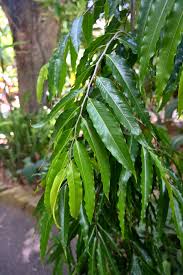
Monoon longifolium (formerly classified as Polyalthia longifolia) is a tall, evergreen tree widely cultivated as an ornamental and medicinal plant across the tropics, including Nigeria. It is prized for its distinctive elegant appearance. The tree grows in a remarkably upright, columnar fashion, with a straight trunk and downward-sweeping branches that are covered in long, narrow, wavy-edged leaves. It can grow up to 20 meters (about 65 feet) tall with a straight bole and symmetrical pyramidal growth form. These leaves, which give the species its name (longifolia meaning “long leaf”), can measure between 15 to 30 cm in length. Although it is a flowering tree, its small, star-shaped, pale green to yellow flowers are inconspicuous and often hidden by the foliage. They typically bloom in the spring and give way to small, oval, dark purple fruit that are attractive to birds. The tree is often mistaken for a palm due to its shape and is extensively used in landscaping for its aesthetic appeal and ability to provide a “sound-breaking” barrier.
Common Names
While Monoon longifolium is not indigenous to Nigeria, it is a common sight in urban landscapes, university campuses, and gardens. Its common names in Nigeria are typically descriptive English names or adaptations of its Indian name.
- English:
- False Ashoka: This is the most widespread common name, distinguishing it from the “true” Ashoka tree (Saraca asoca), which is highly revered in Indian culture.
- Cemetery Tree: Due to its solemn, upright growth habit, it is often planted in graveyards and places of remembrance.
- Green Champa: A name referencing its similarity to other trees in the Magnolia (Champa) family.
- Indian Fir Tree: A descriptive name comparing its tall, narrow shape to that of a fir tree.
- Polyalthia: This is a direct reference to its old genus name and is commonly used by gardeners and nurseries.
- Masquerade Tree: One of the names in Nigeria.
- Hausa: Firin Mast Tree (a Hausa descriptive adaptation referencing its mast-like straightness)
- Igbo: Osisi Ogwu India (loosely translated as “Indian medicine tree,” a descriptive local coinage).
Health Benefits
Monoon longifolium has been utilized in traditional medicine for various health issues, supported by pharmacological studies. Key benefits include:
- Antioxidant Properties: Ethanolic and methanolic extracts from bark, leaves, and seeds scavenge free radicals (e.g., DPPH), reduce ferric ions, and inhibit lipid peroxidation, helping combat oxidative stress.
- Antimicrobial Activity: Leaf and bark extracts exhibit strong antibacterial effects against Gram-positive and Gram-negative bacteria (e.g., Bacillus subtilis, Staphylococcus aureus) and antifungal properties against various fungal strains. Seed oil shows antimicrobial activity against multiple microbes.
- Anti-inflammatory and Analgesic Effects: Traditional use and some research indicate potential for reducing inflammation and pain. Extracts from the leaves and bark have been reported to reduce inflammation and swelling. Methanolic leaf extracts reduce inflammation in animal models, comparable to standard drugs like diclofenac, and provide pain relief.
- Cardioprotective Potential: Decoctions have been used traditionally to support heart health and regulate blood pressure.Some animal studies suggest extracts may help lower blood pressure and cholesterol levels.
- Anticancer Research: Compounds like clerodane diterpenes isolated from the tree have demonstrated cytotoxic activity against certain cancer cell lines in laboratory settings. Stem bark extracts demonstrate cytotoxicity against cancer cell lines (e.g., HeLa, MCF-7) in vitro and reduce tumor growth in vivo.
- Antidiabetic and Hypotensive: Helps lower blood sugar levels and blood pressure, useful for diabetes and hypertension management.
- Other Benefits: Antipyretic (fever reduction), antiulcer, laxative, and mild antimalarial effects against chloroquine-resistant strains; also aids in treating skin diseases, helminthiasis (worm infections), digestive issues, and respiratory conditions like coughs.
Other Benefits
- Ornamental and Landscaping: Its primary benefit is its beauty. It is widely planted in gardens for its aesthetic appeal, noise pollution reduction, and ability to be pruned into shapes; leaves are used for festival decorations.
- Noise Reduction: The dense, evergreen foliage is excellent for reducing traffic and urban noise pollution, earning it the nickname “sound-breaking tree.”
- Timber: The wood is moderately hard and is used for making small objects like boxes, pencils, and matchsticks. Its light weight also makes it suitable for making traditional drums and fishing floats.
- Shade and Windbreak: The tree provides good shade and its strong, flexible wood allows it to withstand high winds, making it an effective windbreak.
- Air purification: The tree is known to absorb noise and filter air pollutants, making it popular in urban landscaping.
How It Is Used
In traditional medicinal contexts (not recommended without expert consultation):
Decoction:
- The bark is boiled in water to create a bitter decoction, which is then consumed in small quantities for fevers, digestive issues, or skin diseases.
- Leaf decoctions are consumed for fever and inflammation.
- Leaves and Bark decoctions or extracts for treating fever, skin conditions, hypertension, diabetes, inflammation, and infections; crushed leaves and bark for coughs and mucus relief.
Essential Oil:
- Oil extracted from the seed is used for antimicrobial and antioxidant applications; used topically or internally for skin diseases and worm infestations.
- Distilled oil from the leaves is used in aromatherapy for stress relief and relaxation.
Paste: The bark or leaves are ground into a paste and applied topically to treat boils, skin rashes, or other skin conditions.
Environmental use: Planted as windbreaks, shade providers, and for roadside beautification.
Side Effects / Caution
No significant toxicity has been reported in studies; methanolic leaf extracts were well-tolerated in rats up to 3.2 g/kg, with only mild hypoactivity observed at high doses. There are no known major side effects, however, the consumption of any part of the Monoon longifolium tree is not advised without medical supervision.
- Toxicity: There is limited data on its human toxicity, but self-medication can be dangerous. The seeds, in particular, are considered toxic and should not be ingested.
- Pregnancy and Lactation: Its safety for pregnant or breastfeeding women has not been established. It is strongly contraindicated.
- Drug Interactions: Due to its potential effects on blood pressure and heart rate, it could interact with cardiovascular medications. Its antioxidant properties might also interfere with chemotherapy drugs.
- Lack of Standardization: There is no standardized, safe dosage for human consumption. The potency of active compounds can vary greatly from tree to tree.
- Allergic reactions: Some individuals may experience skin irritation from direct application of leaf extracts.
- Overconsumption risk: Large doses of decoctions may cause gastrointestinal upset.
References
- “Monoon longifolium.” Wikipedia, Wikimedia Foundation, 16 Sept. 2025, en.wikipedia.org/wiki/Monoon_longifolium. Accessed 16 Sept. 2025.
- “Tree of the Month: Masquerade Tree.” Greens and Sunshine, 9 May 2016, greensandgardens.wordpress.com/2016/05/09/tree-of-the-month-masquerade-tree/. Accessed 16 Sept. 2025.
- Ahmad, Ijaz, et al. “Evaluation of Polyalthia longifolia (Sonn.) for Antioxidant and Antimicrobial Activities.” Journal of Medicinal Plants Research, vol. 5, no. 20, 2011, pp. 5131-36.
- Bhakuni, D. S., et al. “Secondary Metabolites of Polyalthia longifolia.” Journal of Natural Products, vol. 49, no. 2, 1986, pp. 351-52.
- Gajalakshmi, S., and S. Divya. “Pharmacological activities of Polyalthia longifolia: A review.” International Journal of Pharmaceutical Sciences Review and Research, vol. 22, no. 1, 2013, pp. 59–63.
- Jahan, Nusrat, et al. “Phytochemical and pharmacological importance of Polyalthia longifolia.” International Journal of Pharmacy and Pharmaceutical Sciences, vol. 3, no. 2, 2011, pp. 19–23.
- Katkar, K. V., A. C. Suthar, and V. S. Chauhan. “The Chemistry, Pharmacologic, and Therapeutic Applications of Polyalthia longifolia.” Pharmacognosy Reviews, vol. 4, no. 7, 2010, pp. 62-68.
- Kaur, Amandeep, et al. “Polyalthia longifolia: A Review.” Pharmacognosy Journal, vol. 12, no. 5, 2020, pp. 1177-84. DOI: 10.5530/pj.2020.12.165.
- Kothari, Vijay, and Shital Seshadri. “Antimicrobial activity of essential oils against human pathogens and microbes of spoilage.” Asian Journal of Biomedical and Pharmaceutical Sciences, vol. 5, no. 46, 2015, pp. 13–19.
- Kumar, Dinesh, et al. “Polyalthia longifolia: An Indian mast tree with medicinal potential.” World Journal of Pharmaceutical Research, vol. 5, no. 3, 2016, pp. 425–435.
- Maurya, Santosh Kumar, and Satyendra Kumar. “A Review on Phytochemical and Pharmacological Properties of Polyalthia longifolia.” Journal of Pharmacognosy and Phytochemistry, vol. 7, no. 5, 2018, pp. 2404-09.
- Musa, Nma Estu, and T. T. Ayisa. “Medicinal Properties of Polyalthia longifolia (Masquerade Tree).” International Journal of Agriculture and Earth Science, vol. 10, no. 5, 2024, pp. 140-149.
- Ogunmoye, A. O., et al. “Phytochemical Screening and Antimicrobial Activity of Polyalthia longifolia Leaf Extracts against Clinical Isolates.” Journal of Applied Sciences and Environmental Management, vol. 22, no. 8, 2018, pp. 1289-93. DOI: 10.4314/jasem.v22i8.26.
- Ratnam, K. V., and Raju. “Wound Healing Activity of Polyalthia longifolia (Sonn.) Stem Bark.” International Journal of Research in Pharmaceutical and Biomedical Sciences, vol. 3, no. 2, 2012, pp. 601-05.